
Unified Network Theory
Ifa Networking, also known ToE Networking, provides the universal structure underlying all networking theories and models and their applications, including the modern Internet.
An IfaNetwork (IfaNet or the Network of Everything) is a system that uses interdisciplinary, intradisciplinary, transdisciplinary, multidisciplinary, and crossdisciplinary approaches to solving complex problems in society, pooling/crowdsourcing ideas from experts of various disciplines.
On this Network, all the members speak Ifa Language (IfaLang) and use it for learning, designing, and doing other activities.
Also, all fields and disciplines of knowledge ‘talk’ to one another in IfaLang, the Language of Energy (LoE).
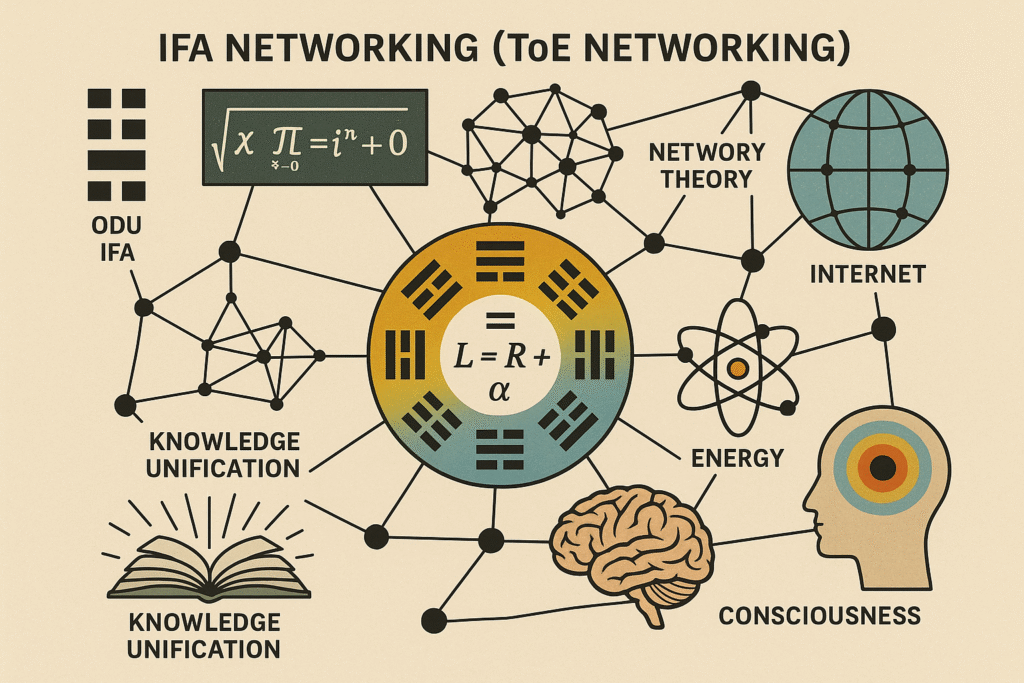

Unified Networking Framework
Ifa Network Science integrates all kinds of networking theories and models, enabling holistic understanding and application for complex societal challenges through the Ifa Language.

Interdisciplinary Integration
Highlighting the fusion of multiple disciplines, this aspect drives effective solutions by connecting theoretical and practical networking perspectives seamlessly.

Innovative Communication Protocol
Focused on the Ifa Language, this element enhances clarity and precision in information exchange, fostering collaboration and advancement across sectors.
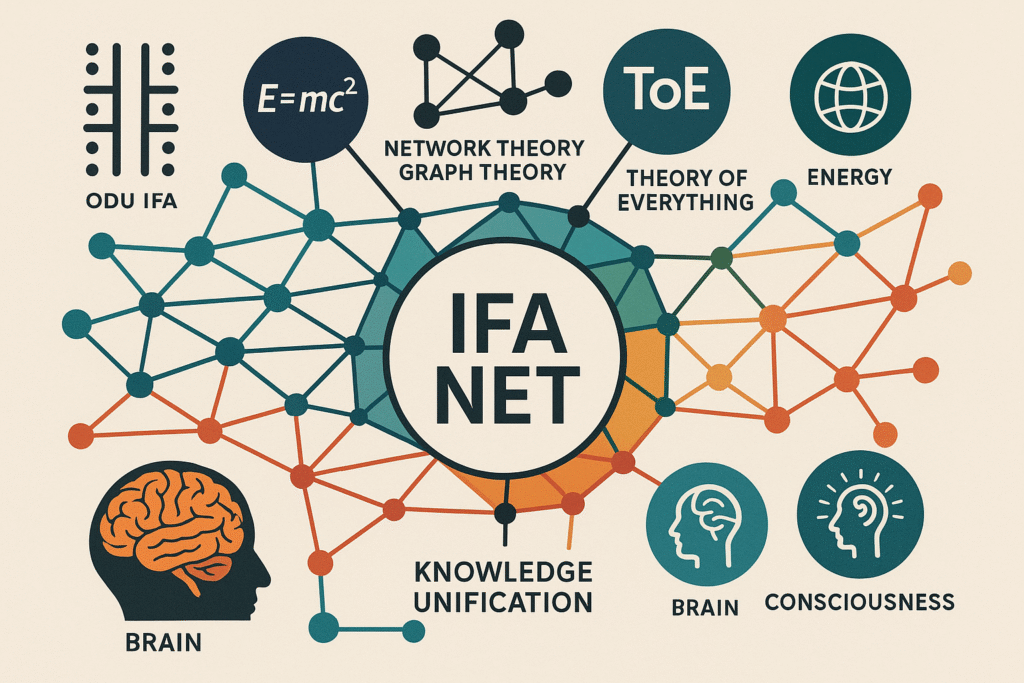
Understanding Ifa Networking
Explore Ifa Nets and Orisa Nets. Discover the core principles of Ifa Networking, guiding you through its universal framework and practical applications to bridge interdisciplinary insights.
1
Step One: Foundations of Ifa Networking
Begin by grasping the fundamental concepts of Ifa Networking, establishing the basis for integrating diverse networking theories and the Ifa Language.
2
Step Two: Applying the Framework
Explore how to implement the Ifa Networking framework in practical scenarios, enabling effective connections across disciplines and societal solutions.
3
Step Three: Advancing Integration
Complete the process by synthesizing insights through the Ifa Language, achieving comprehensive networking unification and impactful outcomes.
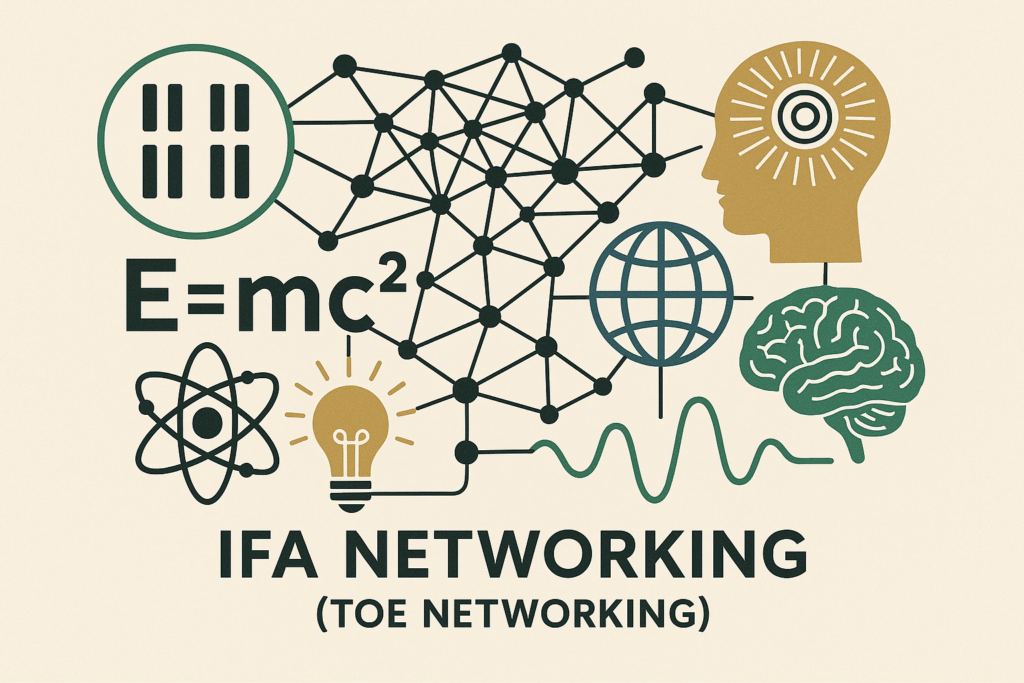
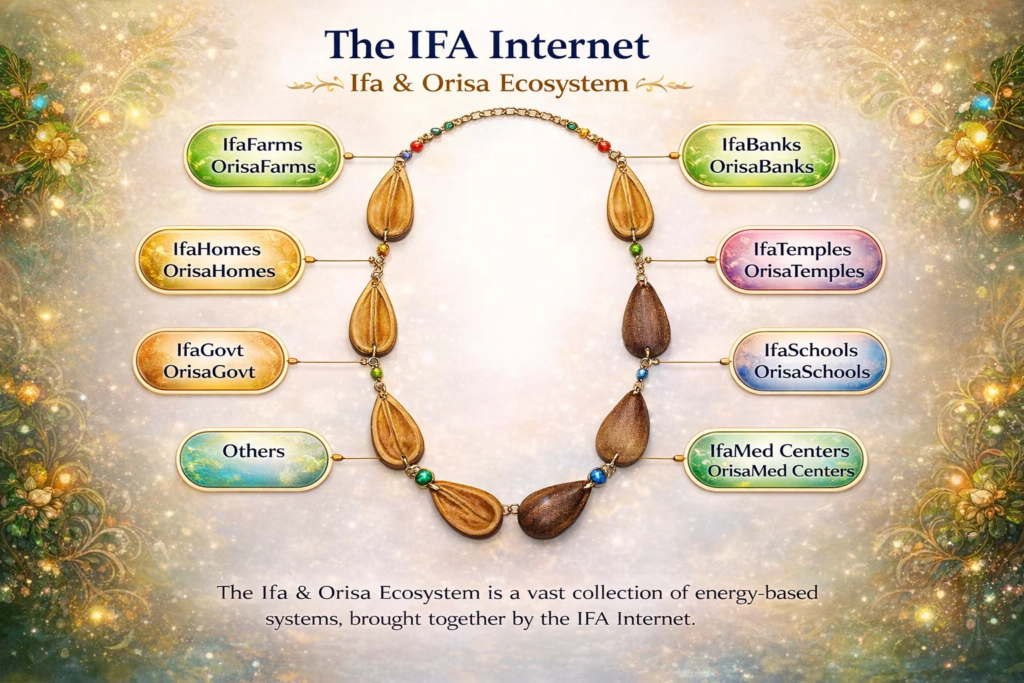
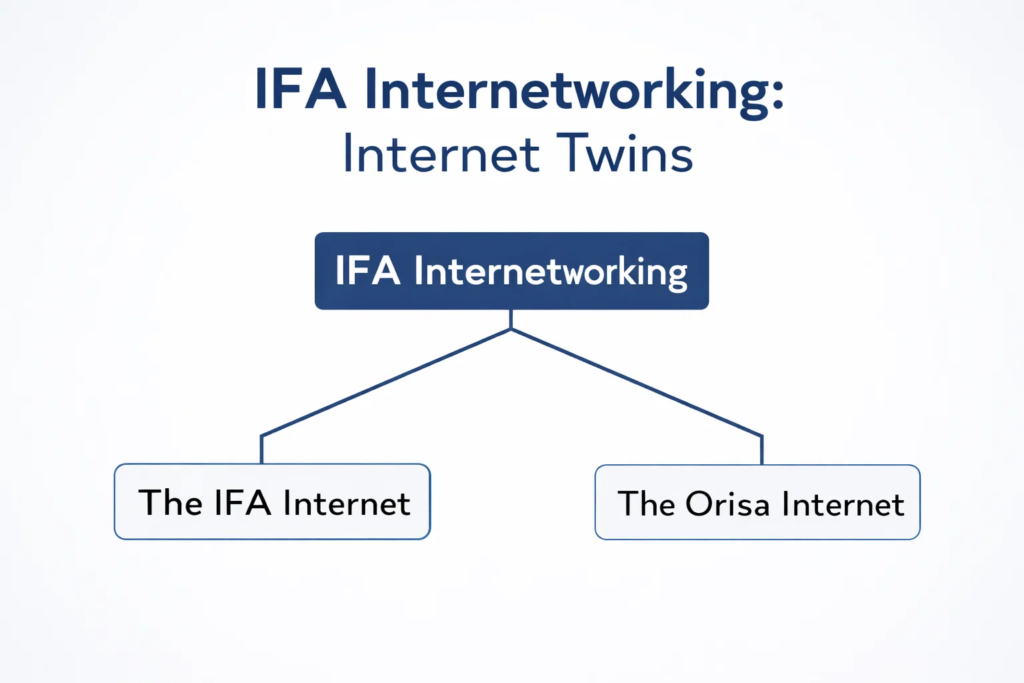
Ifa Internetworking
Internetworking, the practice or act of interconnecting multiple computer networks, can be done in Ifa Language. IFA is the Internet of internets — the Universal Internetworking Technology (UIT).
Learn the Odu Ifa and the Odu Oosa as the Blueprint of all internetworking methods, approaches, and systems.
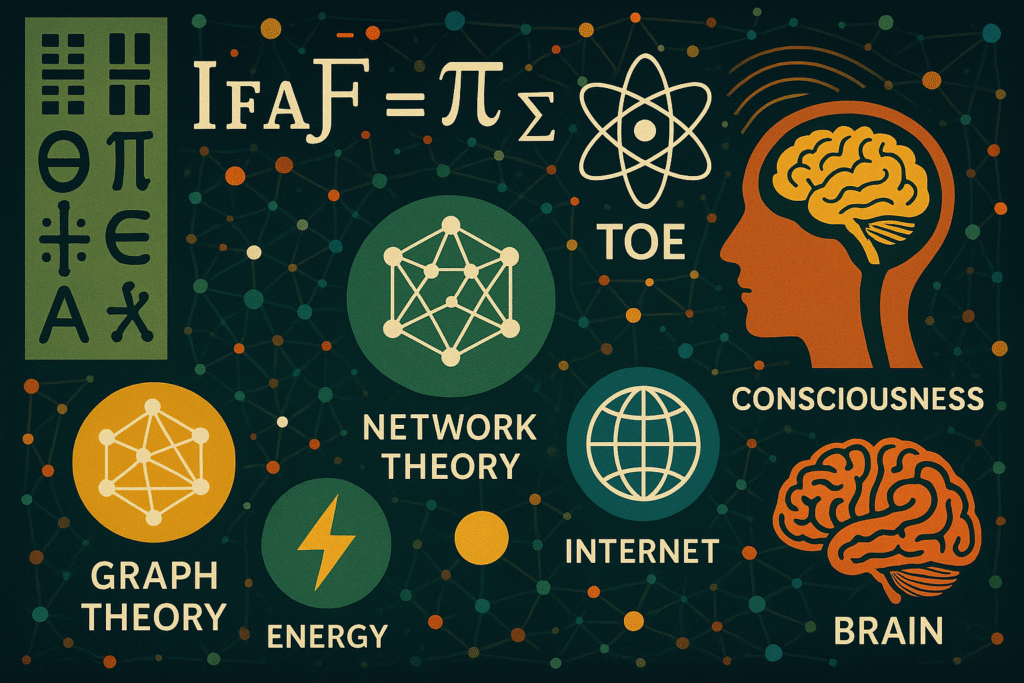

Universal Internetworking Framework
Understand the core Principles uniting diverse networking/internetworking disciplines, methods, or systems within ToE Internetworking (Ifa Internetworking).
IfaHubs/OosaHubs (Ifa Networks & Oosa Networks)
Delve into approaches combining multiple fields for innovative societal solutions.
Ifa Language Innovation
Gain insights into the unique language that enables universal networking communication. Networks are modelled in IfaLang and using Ifabits as IfaGebra (NetGebra) uniting all kinds of networks as One.
The Ifa Bridge
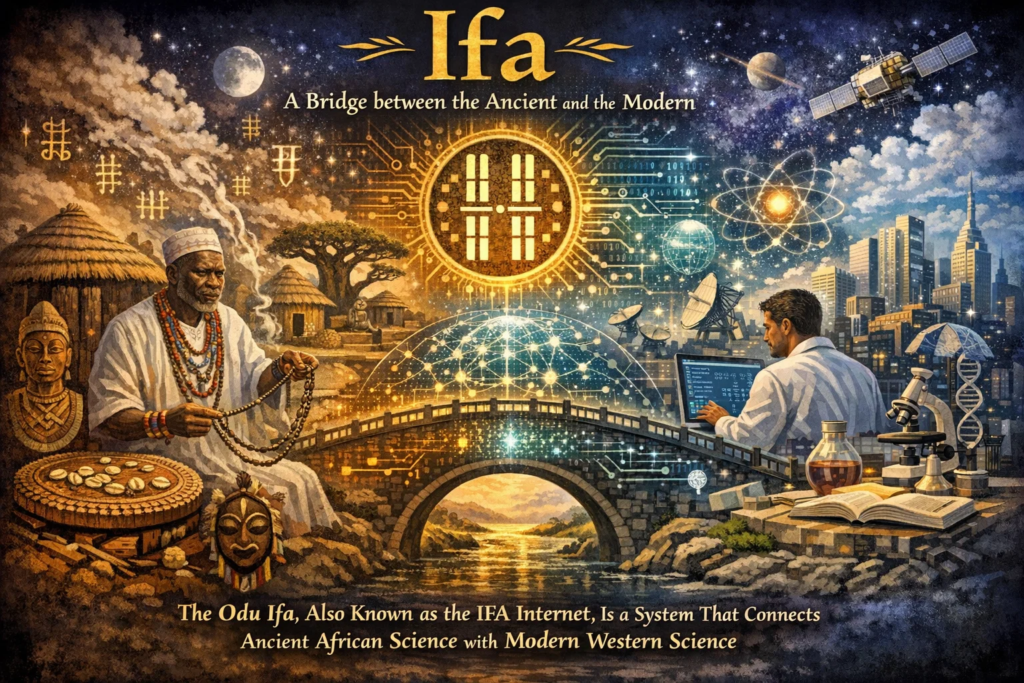
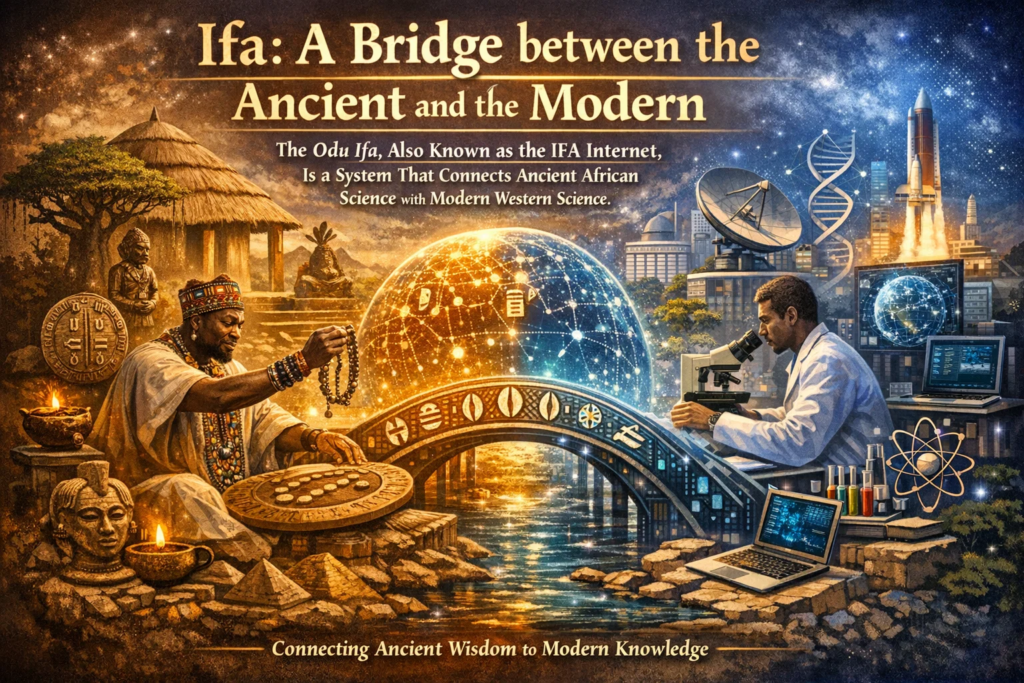
Ifa as a Bridge Between the Ancient and the Modern
One of the most profound ideas within Ifa Networking is the concept of the Ifa Bridge.
The Ifa Bridge represents the role of Ifa as a connecting system between ancient knowledge and modern knowledge, linking diverse intellectual traditions into a unified network of understanding.
In modern academia, knowledge has often been separated into different domains: ancient versus modern, African versus Western, science versus philosophy, and tradition versus technology.
These divisions have shaped how today’s societies organize knowledge and how academic disciplines develop. However, the deeper structure of knowledge, as shown in Ifa, reveals that these divisions are largely artificial.
All civilizations have sought to understand the same fundamental questions about reality, nature, consciousness, and society.
Within the intellectual heritage of Yoruba civilization, the Odu Ifa system represents a remarkable framework for organizing knowledge.
It preserves centuries of accumulated wisdom through its corpus of 256 Odu, each containing numerous verses known as Ese Ifa.
These verses encode information about every field of knowledge, including natural sciences, arts, ethics, cosmology, medicine, governance, and human behavior.
In the context of Ifa Networking, the Odu Ifa can be seen as a knowledge network, where each major Odu, especially Ogbe (Energy) and Oyeku (Non-Energy), functions like a node in a larger informational structure.
The verses within each Odu serve as carriers of knowledge, transmitting ideas, observations, and principles across generations.
The Odu Ifa is a vast System with many elements, all of which are interconnected/internetworked together using the Energy called Ogbe and its superpartner, Oyeku, which is Anergy.
For this reason, the Odu Ifa is called the IFA Internet or the IFA Body of Knowledge (IFABOK), an ancient Internet Tech developed by the Ife mathematician, Orunmila.
The IFA Internet, i.e., the Odu Ifa, is a system that connects Ancient African Science with Modern Western Science.
Ancient African knowledge systems developed sophisticated ways of understanding the natural world.
Within the Ifa tradition, knowledge was preserved through ancient mathematics and metamathematics, symbolic narratives, philosophical reflections, and structured oral transmission.
These systems explored all kinds of knowledge, especially fundamental questions concerning the origin of the universe, the balance of natural forces, health and healing, social order, and the relationship between humanity and nature.
Modern Western science approaches many of the same questions through empirical investigation, mathematical modeling, and technological experimentation.
Fields such as physics, biology, information science, artificial intelligence, and systems theory attempt to uncover the underlying laws governing reality.
The concept of the Ifa Bridge posits that these two traditions are not inherently opposed but rather represent complementary approaches to knowledge.
Ancient traditions often encoded knowledge in mathematical, symbolic, and philosophical frameworks, while modern science expresses knowledge through mathematical language and experimental verification.
By linking these perspectives, Ifa can serve as a conceptual bridge that encourages dialogue between Ancient African Science and Modern Western Science.
The Bridge also extends beyond science into philosophy. African philosophy, particularly within Yoruba thought, emphasizes relational existence, harmony, community, and the interconnectedness of all things.
Western philosophy, on the other hand, has developed powerful traditions of logical analysis, epistemology, and scientific realism. Both traditions address universal questions about reality, knowledge, ethics, and consciousness.
The Ifa Bridge creates a space where these philosophical traditions can interact, complementing one another in the search for deeper understanding.
In the modern era, the Internet has become humanity’s most powerful knowledge network, connecting billions of people and enabling the rapid exchange of information across the world.
The IFA Internet extends this idea by stating that the Odu Ifa represents an ancient model of a knowledge network that mathematically organizes all kinds of knowledge into interconnected structures using Energy-based approaches or Ifapproaches.
The modern Internet connects computers and digital information.
It is the same way the Ifa System bridges the gap between the disconnected fields of knowledge in modern education systems, connecting cultural knowledge, philosophical insights, scientific observations, ethical principles, and all fields of knowledge within a single Framework.
Within Ifa Networking, this bridge plays a central role in the broader vision of knowledge unification.
Human knowledge today is highly specialized and fragmented across many disciplines.
Universities and research institutions divide knowledge into separate fields such as physics, biology, economics, philosophy, and engineering. While specialization has produced remarkable advances, it has also created intellectual silos.
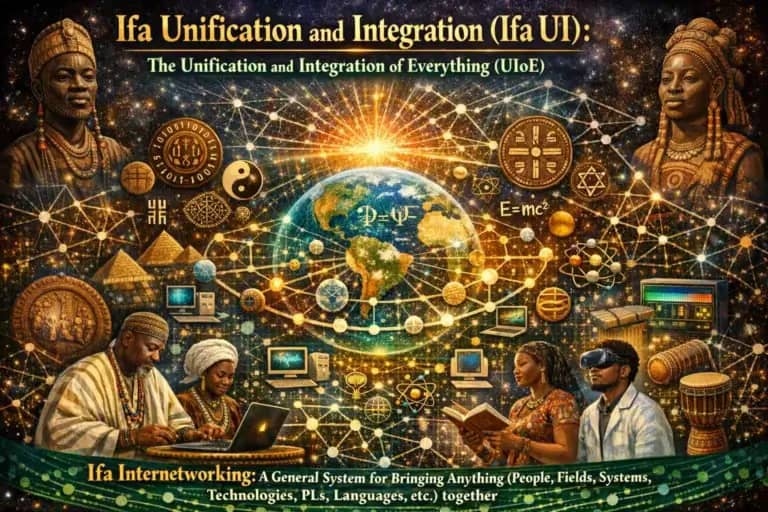
The Ifa Bridge supports the vision of UIoE — the Unification and Integration of Everything.
In this Framework, knowledge from all domains can be integrated into a single interconnected System called the IFA Internet.
Physics connects with mathematics.
Biology connects with chemistry.
Information science connects with cognition.
Philosophy connects with science and culture.
Through its deep metamathematics, symbolic structure, philosophical depth, and network-like organization, Ifa provides a conceptual model for linking these different domains together.
Within the broader architecture of Ifa Networking, the Ifa Bridge therefore represents more than a cultural metaphor.
It represents a knowledge integration mechanism —a way of connecting ancient wisdom with modern scientific inquiry, African intellectual traditions with global scholarship, and traditional philosophy with contemporary technology.
By serving as a bridge between the ancient and the modern, Ifa contributes to the larger mission of building a unified global knowledge network dedicated to the Unification and Integration of Everything.
Ifapedia: Ifa Knowledge Base (IKB)
Ifapedia is the encyclopedia of Ifa Sciences and Ifa Non-Sciences (Ifa Arts and Humanities). Discover comprehensive resources integrating all fields and disciplines in IfaLang.
Examine Ifa Graph Theory, a program in IFA Mathematics, where we learn/do Graph Theory in IfaLang. Dive deep into Ifa Network Sciences and data processed/structured in IfaLang, enhancing accuracy and consistency in Ifa Information.
Ifapedia combines the highly collaborative features of wikis with the structured and authoritative elements of knowledge bases, ensuring decentralization, accuracy, and consistency.