
1. Introduction
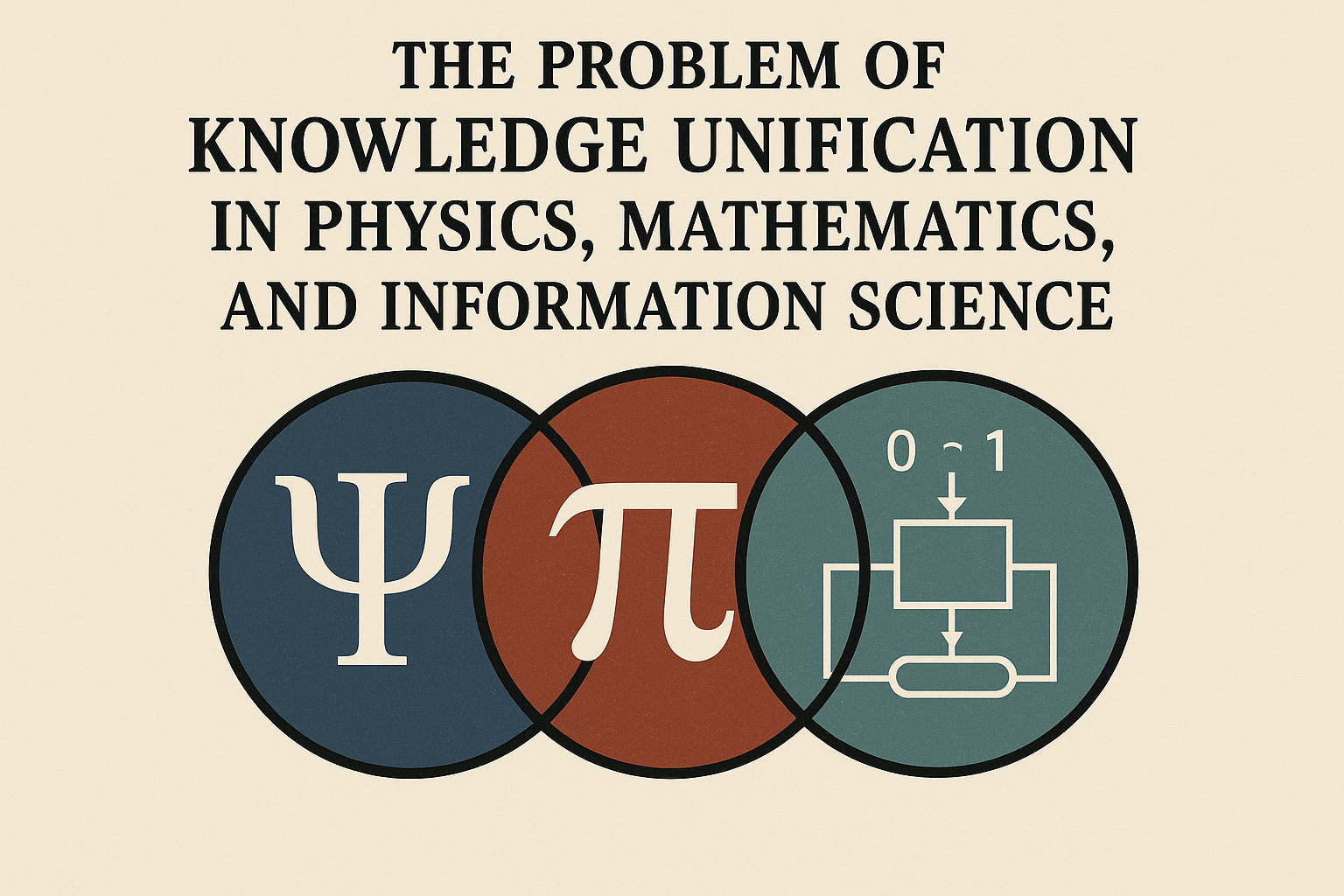
Knowledge unification—the attempt to express diverse phenomena using a single coherent framework—is a driving force across scientific disciplines. In Physics, it manifests in the search for a Grand Unified Theory (GUT) and ultimately a Theory of Everything (TOE).
In Mathematics, it appears in attempts to unify structures, logics, and foundations. In Information Science, it emerges as efforts to create meta-languages and schemas capable of representing any domain of knowledge in a machine-interpretable form.
Despite substantial progress, full unification remains an unsolved challenge in Western science.
This article examines the core unification problems in Physics and Mathematics, evaluates proposed solutions, and reviews knowledge-unification languages in information science.
2. The Problem of Knowledge Unification in Physics
2.1 Fragmented Physical Theories
Modern physics rests on two extraordinary but incompatible frameworks:
- General Relativity (GR) — describes gravity, the curvature of spacetime, and macroscopic phenomena (Einstein, 1915).
- Quantum Mechanics (QM) — describes microscopic behavior of particles and fields (Dirac, 1930; Heisenberg, 1927).
These theories succeed independently but fail when applied simultaneously, such as in black holes, the Big Bang, and Planck-scale physics.
2.2 The GUT Problem
A Grand Unified Theory (GUT) seeks to unify the three non-gravitational forces:
- Electromagnetism
- Weak nuclear force
- Strong nuclear force
Proposed GUT frameworks include:
- SU(5) Georgi–Glashow model (Georgi & Glashow, 1974)
- SO(10) models
- Pati–Salam model
These theories predict phenomena like proton decay, which remains unobserved, leaving GUTs experimentally incomplete.
2.3 The TOE Problem
A Theory of Everything (TOE) would unify all four fundamental forces:
- Electromagnetic
- Weak
- Strong
- Gravitational
Prominent TOE candidates include:
- String Theory / M-Theory (Green, Schwarz & Witten, 1987)
- Loop Quantum Gravity (Rovelli & Smolin, 1995)
- Causal Set Theory (Sorkin, 2005)
- Emergent gravity and entropic gravity models (Verlinde, 2011)
The TOE problem remains unsolved in Western science because gravity resists quantization and the mathematical machinery of known theories is incomplete or untestable.
3. The Problem of Knowledge Unification in Mathematics
3.1 Fragmented Foundations
Mathematics is built on diverse foundational systems:
- Set theory (ZFC)
- Category theory
- Type theory (Homotopy Type Theory, Martin-Löf type theory)
- Model theory
- Algebraic foundations
These systems describe mathematics differently, leading to:
- incompatible logics
- different definitions of infinity
- differences in allowable constructions
- gaps in formal definability
3.2 Historical Attempts at Unification
(a) Hilbert’s Program
An early attempt to formalize all mathematics into a consistent axiomatic system
(Hilbert, 1900).
Gödel’s incompleteness theorems (1931) proved this impossible: any sufficiently rich system is incomplete.
(b) Bourbaki and Structuralism
The Bourbaki group attempted to unify mathematics through structures (1950s), emphasizing:
- groups
- rings
- topological spaces
- vector spaces
Although influential, this did not create a single foundational system.
(c) Category Theory as a Unifying Framework
Category theory (Eilenberg & Mac Lane, 1945) describes mathematical objects via:
- objects
- morphisms
- functors
- natural transformations
It is widely considered a modern path toward mathematics unification.
(d) Homotopy Type Theory (HoTT)
HoTT and the Univalent Foundations (Voevodsky, 2013) aim to unify:
- logic
- topology
- algebra
- computation
via a single homotopy-theoretic foundation.
3.3 Current Issues
Despite advances:
- no universal ontology of mathematical objects exists
- different branches still use incompatible languages
- computational mathematics introduces new representations (e.g., type theoretic languages)
Mathematics remains “unified locally, fragmented globally.”
4. Bridging Physics and Mathematics: Why Unification Is Hard
4.1 Different scales and regimes
Physics models vary drastically between cosmic (GR) and quantum (QM) scales.
4.2 Mathematical plurality
Different mathematical frameworks better suit different physical theories:
- GR uses differential geometry
- QM uses Hilbert spaces and operator theory
- QFT requires functional analysis and renormalization
“It is quite likely that the 21st century will reveal even more wonderful insights than those that we have been blessed with in the 20th. But for this to happen, we shall need powerful new ideas, which will take us in directions significantly different from those currently being pursued” (Penrose, 2005).
4.3 Conceptual clashes
Time, space, probability, causality, and energy behave differently in each regime.
5. Proposed Solutions Toward Unification
5.1 In Physics
- String/M-Theory: unifies particles as vibrating strings; mathematically elegant but not testable.
- Loop Quantum Gravity: quantizes spacetime itself; background-independent.
- Asymptotic Safety (Weinberg, 1979): gravity may be renormalizable at high energies.
- Causal Dynamical Triangulations (Ambjørn & Loll): spacetime emerges from discrete simplices.
- Emergent Gravity Models (Verlinde): gravity is not fundamental but statistical.
5.2 In Mathematics
- Category-theoretic foundations (Lawvere)
- Univalent Foundations & HoTT
- Topos theory as a universal “mathematical universe”
- Unified algebraic frameworks (e.g., universal algebra, operads)
5.3 Cross-Disciplinary Efforts
- Geometric Langlands Program
- Topological quantum field theory (TQFT) as a bridge between physics and category theory
- Information-theoretic physics (quantum information, entropic gravity)
6. Knowledge Unification Languages in Information Science
Information science already confronts knowledge fragmentation in practical terms. Various languages have been developed to represent any domain of knowledge.
6.1 Ontology Languages
- OWL (Web Ontology Language)
- RDF / RDFS
- SKOS
- DAML+OIL
These languages unify knowledge using triples, classes, relations, and axioms.
6.2 Metamodeling Languages
- UML / SysML
- MOF (Meta-Object Facility)
- Ecore (Eclipse Modeling Framework)
These aim to unify system representations across software domains.
6.3 Semantic networks and logical languages
- CycL (Cycorp): one of the largest unification ontologies
- KIF (Knowledge Interchange Format)
- Common Logic (ISO/IEC 24707)
- Prolog / Datalog: logic-based unification languages
6.4 Domain archetype systems
- openEHR Archetypes
- ISO 13606 Archetype Models
Archetypes are domain-specific knowledge templates that organise information independent of technical implementation.
6.5 Universal schemas
- Google’s Knowledge Graph schema
- Schema.org
- WordNet / ConceptNet
These provide cross-domain conceptual unification.
7. Synthesis: Toward a Universal Knowledge Unification Framework
The struggles of Physics, Mathematics, and Information Science share themes:
- multiple incompatible languages
- multiple scales of description
- need for semantic interoperability
- need for new meta-frameworks
- emergence of category theory and graph-based models as unifiers
Modern trends suggest that graph-based, category-theoretic, or information-theoretic approaches may offer future integrative frameworks.
8. Conclusion
The problem of knowledge unification remains one of the greatest scientific challenges. In Physics, it is embodied in the search for a GUT and ultimately a TOE. In Mathematics, it arises from multiple competing foundational systems. In Information Science, it appears in attempts to create universal semantic frameworks.
Despite incomplete success, progress in string theory, quantum gravity, category theory, homotopy type theory, and ontology languages demonstrates that unification is possible—though perhaps requiring new abstractions and mathematical inventions.
On the IFA Internet, Energy (Ogbe) is revealed as the solution to this grand problem of knowledge unification in modern fields. However, continued interdisciplinary research collaborations are needed to build applications of this discovery.
References
- Einstein, A. (1915). The Field Equations of Gravitation.
- Dirac, P. A. M. (1930). The Principles of Quantum Mechanics.
- Georgi, H., & Glashow, S. L. (1974). Unity of All Elementary Particle Forces. PRL.
- Green, M., Schwarz, J., & Witten, E. (1987). Superstring Theory.
- Eilenberg, S., & Mac Lane, S. (1945). General Theory of Natural Equivalences.
- Voevodsky, V. (2013). Univalent Foundations Project.
- Penrose, R. (2005). The Road to Reality.
- Rovelli, C., & Smolin, L. (1995). Spin Networks and Quantum Gravity.
- Sorkin, R. (2005). Causal Sets: Discrete Structure of Spacetime.
- ISO/IEC 24707 (Common Logic).
- Beale, T. (2005). Archetypes: Constraint-Based Domain Models for OpenEHR.
Leave a Reply