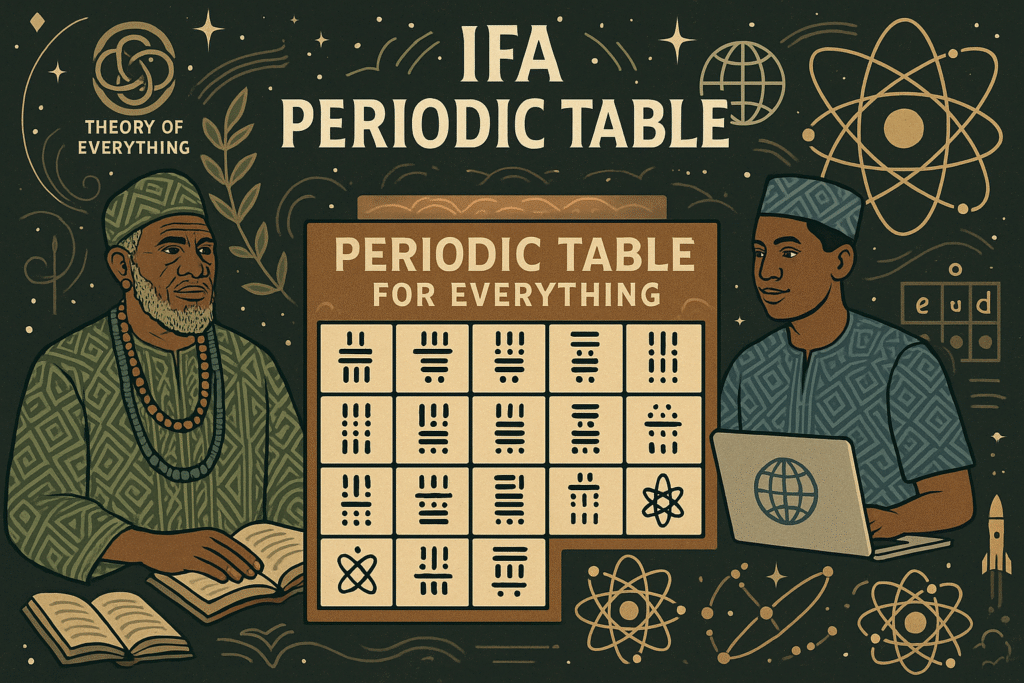
Ifa Periodic Table (IfaPT): ToE Periodic Table (ToEPT)

Mapping the Building Blocks of All Fields of Knowledge

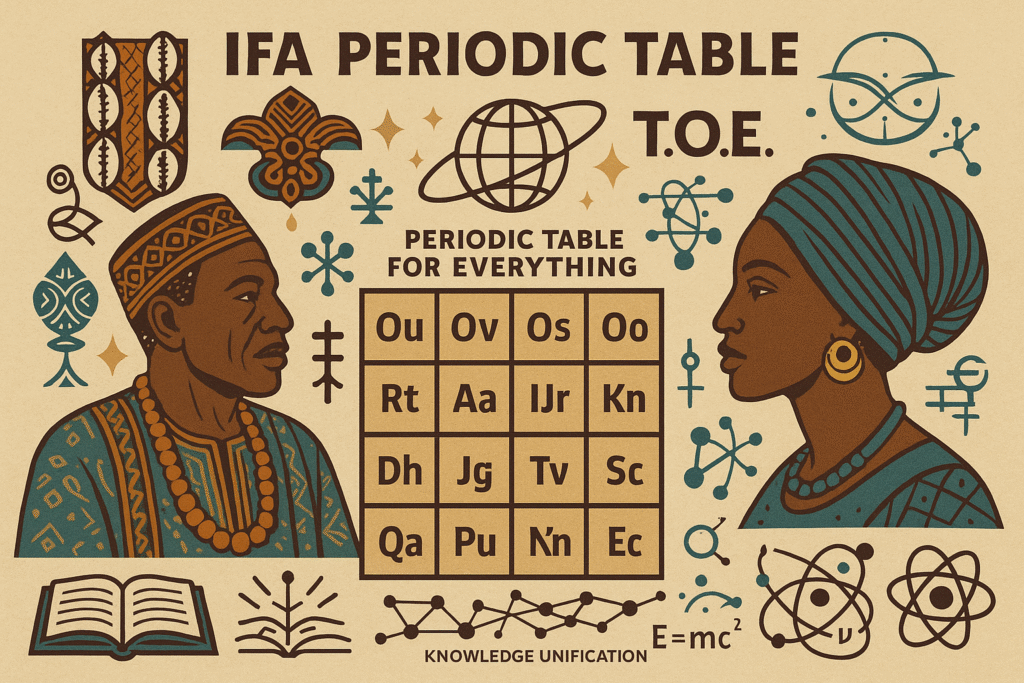
The Ifa Periodic Table is the Periodic Table of Everything (PToE), rooted in the 16 Ifa Axioms, showcasing its role in unifying Chemistry and all other fields for knowledge unification and integration (KUI).

The PToE is a key element of IFA Mathematics and is also known as ToE Periodic Table or CEN Periodic Table.

It classifies all elements (i.e., aspects of nature, including all fields of knowledge) according to their Energy signatures/properties (Odu Ifa).

Also known as the Periodic Table of Energy, it generalizes the periodic table in Chemistry, which classifies elements according to their chemical properties, to all dimensions of knowledge possible (and impossible) both in the sciences and non-sciences.

The IfaPT is a periodic table builder or generator and a Tool that allows you to study the periodicity and aperiodicity of everything, including every field.
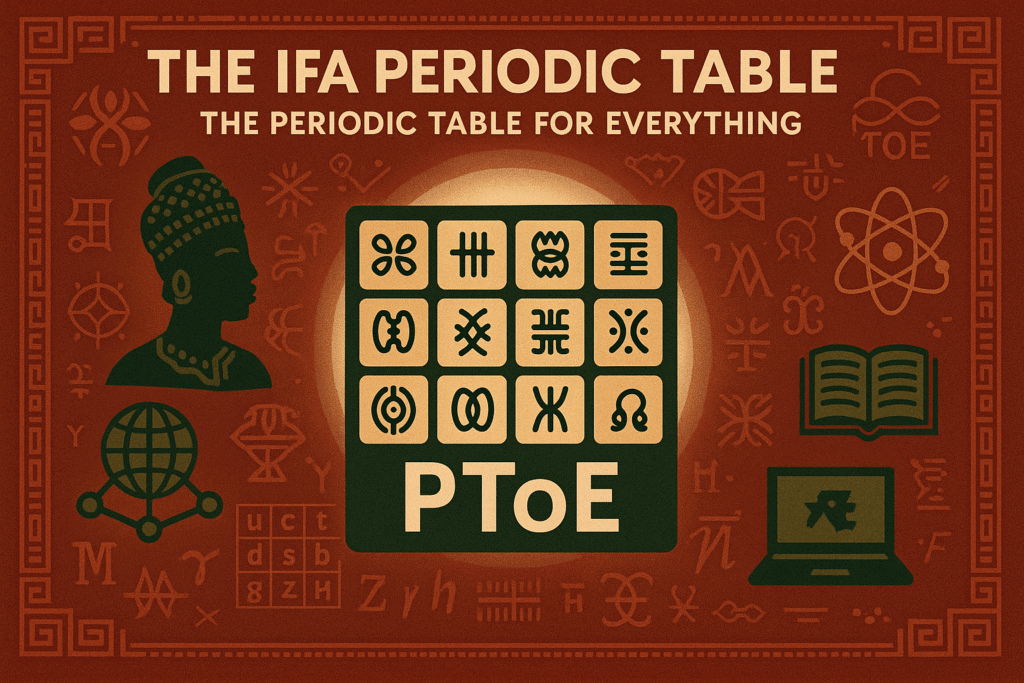
Dive Into The Core Features of the Ifa Periodic Table

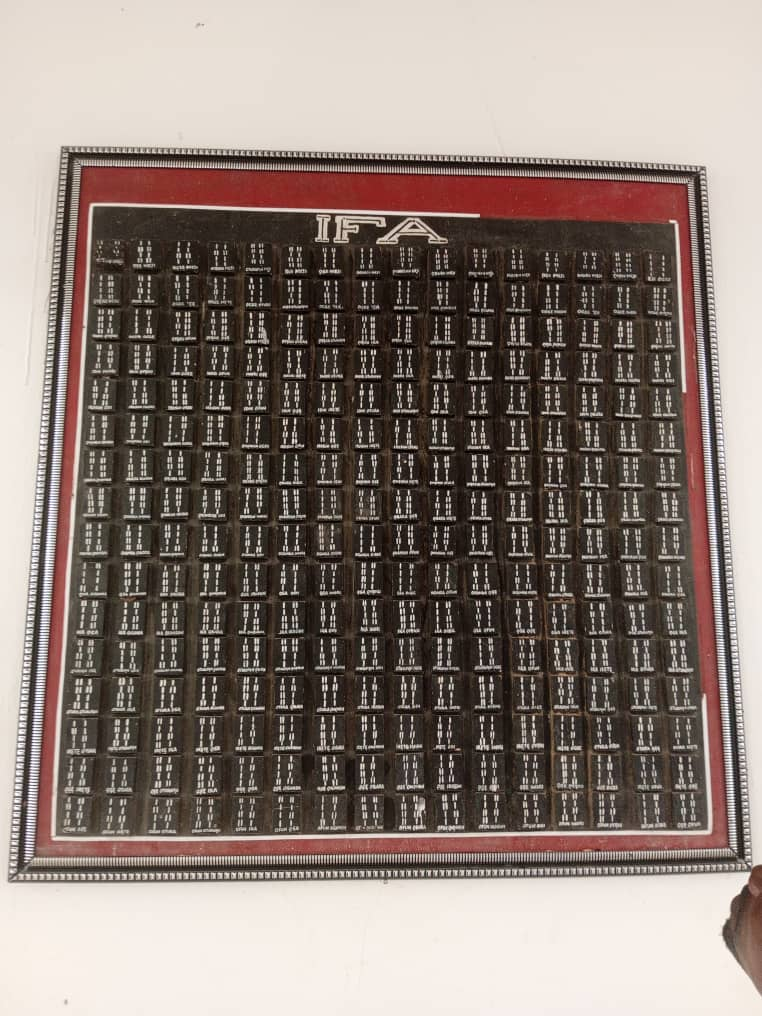
The Chart features 256 Ifa Elements in total, arranged into 16 Groups called Ojú Odù Ifá Mẹ́rìndínlógún (16 Principal Ifá Codes) and 16 Periods containing 240 amulu Odù (Composite Ifá Codes) or ọmọ Ọdù.

Here are some key features of the PToE:

Ifa Matrix Framework

Uncover the foundational principles of Ifa Matrix, shaping the Theory of Everything. The IFA Matrix, also known as the STEAMSEX Matrix, is the underlying Structure of the PToE.

Integrated Disciplines

Learn how Chemistry and all other fields converge and harmonize within the PToE and TOE.

The Periodic Table of Lifeforms on Earth (PTL)

Discover the innovative PTL system, an open-source tool that searches for, studies, and classifies Energy patterns (CEN patterns) underlying all living organisms on this planet based on their level of consciousness and other key factors essential to life.
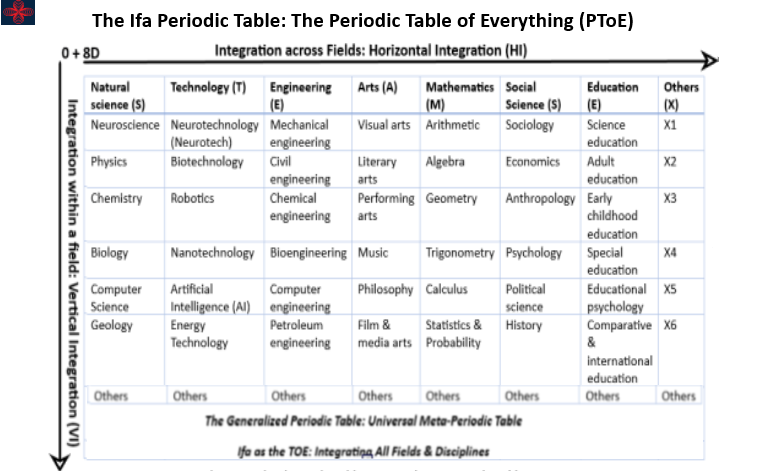
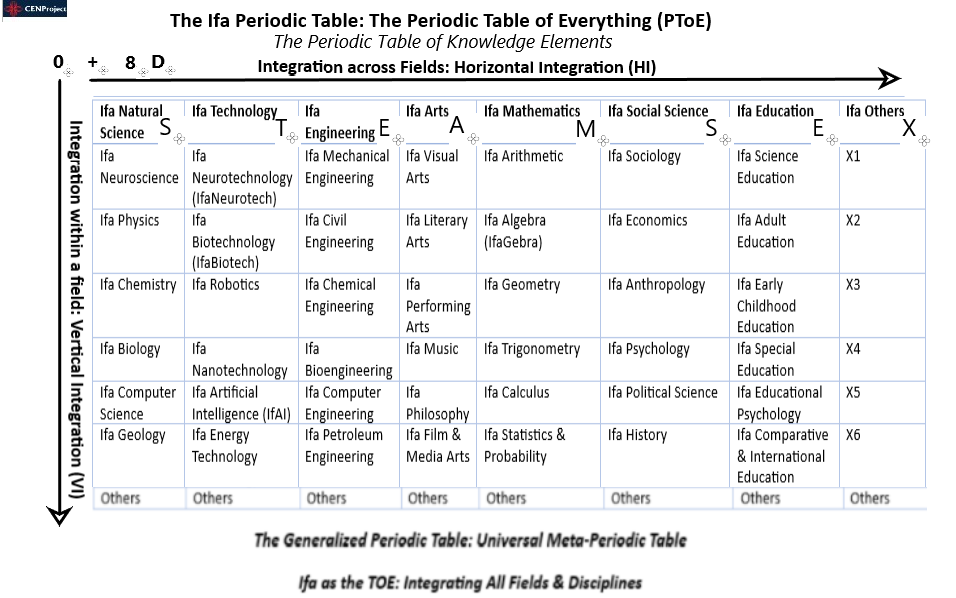
The Compact Form of Ifa’s Periodic Table
The Dual Form of Ifa’s Periodic Table
The Matrix Form of Ifa’s Periodic Table

Click the picture to see an enlarged version of the Table and download it.

Discover Ifa’s Periodic Table

The PToE presents IFA as the Standard Model of Interdisciplinary Studies. It is a meta-mathematical structure that shows the interconnectedness of all fields of knowledge.
Explore the Ifatoms as the Building Blocks of Knowledge

Ifatoms are the Atoms of Everything (AtomoE), generalizing the atomic models in physical sciences, especially Chemistry and Physics, to all dimensions of knowledge.
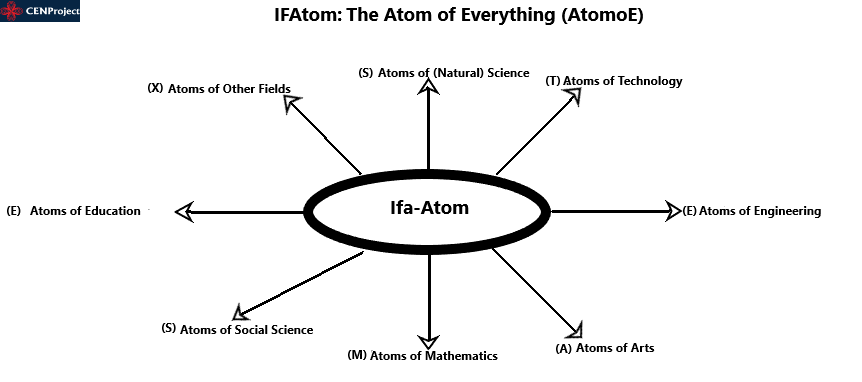
Ifatoms are the 256 Odu Ifa and are the most basic building blocks of all fields and disciplines of knowledge.

IfaPT as Periodic Table Builder

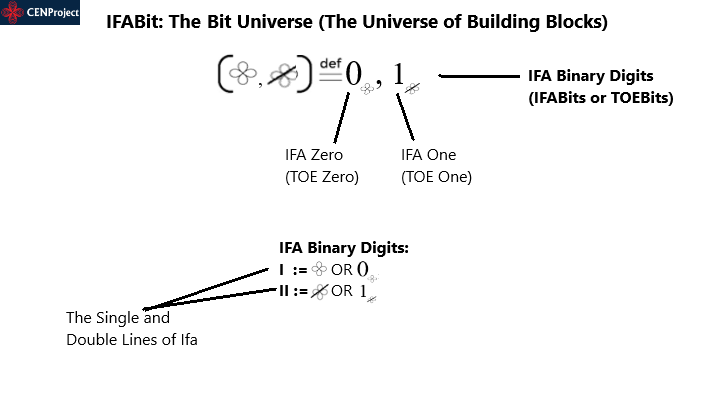
Every field of knowledge has its own periodic table made of its ifatoms (building blocks or ifabits) and Energy patterns/signatures, showing that Energy (Ogbe) is the underlying Architecture of Chemistry and all fields generally.

The IfaPT is a periodic table builder or generator and a Tool that allows you to study the periodicity and aperiodicity of everything, including every field.
16 Ifa Axioms

This topic introduces the core Principles behind IFA Mathematics.

IFABit Integration

This topic examines how IFABit powers this universal model.

Unified Disciplines

Dive into how Chemistry and all other fields are seamlessly integrated via the TOE Field Nomenclature.

Ifa Periodicity: Periodic Laws or Trends in Ifa

Periodicity refers to the property of a pattern, function, event, or phenomenon that repeats itself at regular intervals over time, space, or another variable.
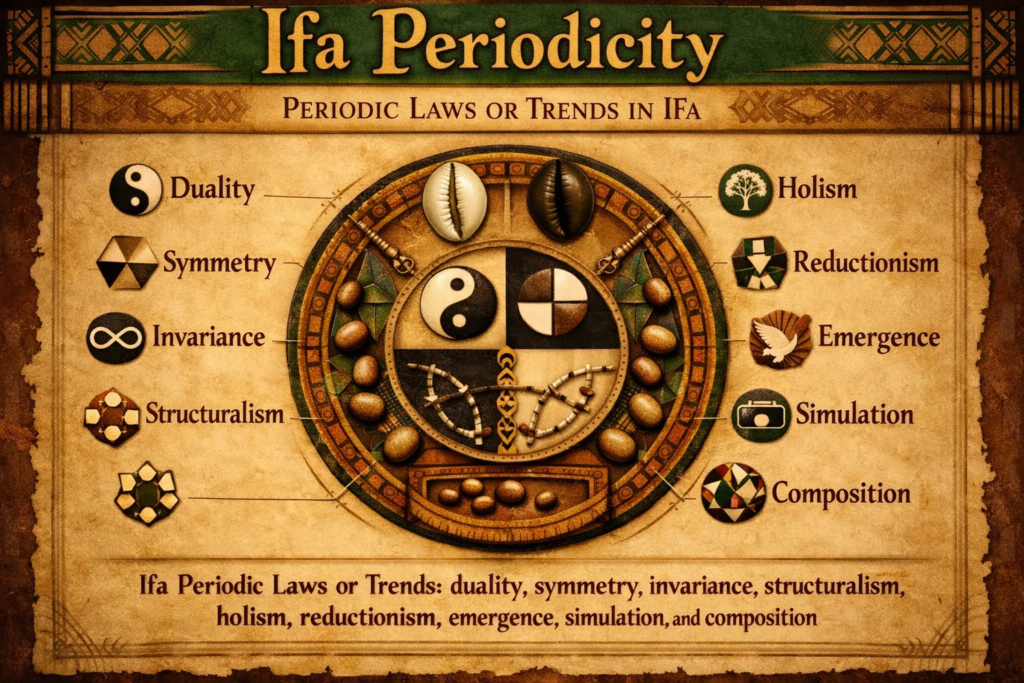
The periodic laws or trends of Ifa are duality, symmetry, invariance, composition, structuralism/holism, emergence, simulation, and reductionism.
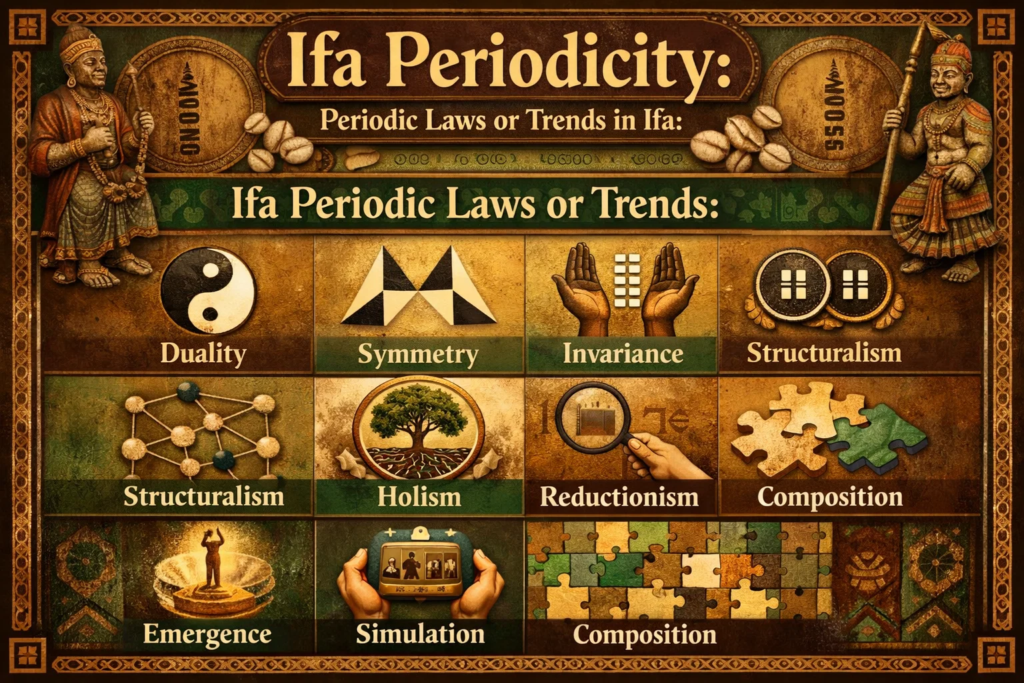
These are general, universal, deep, and fundamental principles that the ancient polymath and mathematician, Orunmila, used to organize and structure all kinds of knowledge and model everything in existence mathematically.

The Fundamental Principles of Ifa Underlying All Fields and Nature

The core principle of Ifa is that everything in existence, including Existence itself, recycles and has its own Odu that birthed it.

Ifa Duality

Duality means that one reality, system, or concept can be understood in two complementary but different ways, and both perspectives are true and necessary.

The concept refers to the state of having two parts, aspects, or opposing ideas that exist together, like good and evil, or light and shadow, often creating a tension or balance, and it appears in philosophy (mind/body), physics (wave/particle), and math (interchangeable concepts).

Essentially, it’s about two complementary or conflicting forces/concepts viewing the same underlying reality from different perspectives, such as the wave-particle duality in quantum mechanics, where light acts as both.

The Ying and Yang Symbol
The Tibi Tire (Union of Opposites) Symbol

Duality can mean double or inverse, depending on the context, and there are different areas of Ifa that explain both. Duality in the Odu Ifa is what is referred to as IfaDuality.

Ifa Double

The IfaDoubles are known as Oju Odu Ifa Merindinlogun in Yoruba, meaning the 16 Principal Ifa Codes. They are the Ifa Laws of Nature governing all fields of knowledge and everything in existence.

Also known as ToE Double, ToE Construction, Energy Double, Ifa Mirror Symmetries, or Ifa Construction, Ifa Double is a more general form of Cayley-Dickson Double (CD Double) or Cayley-Dickson Construction, developed by the ancient African mathematician Orunmila thousands of years ago.

IfaDouble covers all fields of knowledge, unlike CD Double that is only limited to the realm of Mathematics, and other dualities, such as wave-particle duality (in Physics), limited to just one discipline or the other.

The Ejiogbe Double

The Oyeku Meji Double

The Iwori Meji Double

The Odi Meji Double

The Irosun Meji Double

The Owonrin Meji Double

The Obara Meji Double

The Okanran Meji Double

The Ogunda Meji Double

The Osa Meji Double

The Ika Meji Double

The Oturupon Meji Double

The Otura Meji Double

The Irete Meji Double

The Ose Meji Double

The Ofun Meji Double

Cayley-Dickson Double. Source: MaplePrimes
Photo credit: Wikipedia

Ifa Inverse

The IfaInverses or IfaDuals are 8 in number fundamentally. This is expressed in the Tibi Tire Èjìwapọ̀ principle, known as superposition in modern science.

The Tibi Tire Èjìwapọ̀ Principle

Ejiogbe is the Ifa Inverse of Oyeku Meji; Iwori Meji is the Ifa Inverse of Odi Meji; Irosun Meji is the Ifa Inverse of Owonrin Meji; Obara Meji is the Ifa Inverse of Okanran Meji; Ogunda Meji is the Ifa Inverse of Osa Meji; Ika Meji is the Ifa Inverse of Oturupon Meji; Otura Meji is the Ifa Inverse of Irete Meji; and Ose Meji is the Ifa Inverse of Ofun Meji.

Each Odu Ifa and its Dual forms an Ifa pair:

Douinfinity (Double Infinity) and its Dual, Non-duoinfinity/Duoninfinity (Double Ninfinity)
Ifa Infinity (Double Infinity), and its Dual, Ifa Ninfinity (Double Ninfinity). Ninfinity (Non-infinity) isn’t the same as finiteness.

Ifa Symmetry

At its deepest level:

Symmetry means invariance under transformation.

Something is symmetric if you can transform it in some way — rotate it, reflect it, shift it — and it still remains fundamentally unchanged.

Symmetry is one of the most powerful organizing principles in mathematics, physics, art, and even biology.

Its opposite is asymmetry, the absence of symmetry.


Simple Intuition

A square rotated 90° still looks the same.

A face reflected in a mirror may look similar.

A snowflake rotated 60° looks unchanged.

That “unchanged under transformation” property is symmetry.


Geometric Symmetry

Example: Rotational Symmetry

Image
Image
Image
Image

A square has:

  • 4 rotational symmetries
  • 4 reflection symmetries

The collection of all its symmetries forms a mathematical structure called a group.


Types of Symmetry

1️⃣ Reflection Symmetry

Mirror invariance.

2️⃣ Rotational Symmetry

Rotation leaves object unchanged.

3️⃣ Translational Symmetry

Shifting position changes nothing (e.g., wallpaper patterns).

4️⃣ Time Symmetry

Physics behaves the same forward and backward in time (in some cases).

5️⃣ Gauge Symmetry

More abstract — central to modern physics.


Symmetry in Mathematics: Groups

The mathematical language of symmetry is group theory.

A symmetry group contains:

  • All allowed transformations
  • Rules for combining them

Example:
The symmetries of a square form a group of 8 elements (called the dihedral group).

This connects symmetry to deep algebra.


Symmetry in Physics

Modern physics is almost entirely built on symmetry.

Examples:

  • Rotational symmetry → conservation of angular momentum
  • Time symmetry → conservation of energy
  • Translational symmetry → conservation of momentum

These connections are formalized in Emmy Noether’s theorem:

Every continuous symmetry corresponds to a conservation law.

This is one of the deepest principles in science.


Lorentz Symmetry

In relativity, spacetime obeys Lorentz symmetry (named after Hendrik Lorentz).

This means:

The laws of physics are invariant under spacetime transformations between inertial observers.

Without this symmetry:

Modern physics collapses.


Broken Symmetry

Symmetry does not always remain visible.

Example:

A perfectly round ball on a hilltop is symmetric.

When it rolls down, it chooses a direction.

The laws are symmetric — the outcome is not.

This is called:

Spontaneous symmetry breaking

It explains:

  • Phase transitions
  • The Higgs mechanism
  • Pattern formation

Symmetry in Ifa

Ifa Symmetry, the Symmetry of Everything (SymoE), involves studying symmetry in IfaLang, specifically focusing on the Four Symmetric Ifa Codes known as the Ifa Four: Ogbe Symmetry, Oyeku Symmetry, Iwori Symmetry, and Odi Symmetry:

The Four Ifa Symmetries: Ogbe Symmetry, Oyeku Symmetry, Iwori Symmetry, and Odi Symmetry.
Ifa-Symmetry: The Symmetry for Everything

Ifa Asymetry (Ifasymetry)

Ifa Asymetry is the Asymetry of Everything. There are 12 Major Asymetric Ifa Codes: Irosun, Owonrin, Obara, Okanran, Ogunda, Osa, Ika, Oturupon, Otura, Irete, Ose, Ofun:

Ifasymmetry: The Asymmetry for Everything

Ifa Mirror Symmetry: Mirror Symmetry in Ifa

Mirror symmetry means:

An object looks the same after being reflected in a mirror.

If you place a mirror along a line (or plane), the reflected image matches the original shape.

This type of symmetry is also called reflection symmetry.


2️⃣ Geometric Examples

Image
Credit: Orchids International School
Image
Credit: Orchids International School
Image
Credit: ClipArts ETC
Image

Examples:

  • A butterfly has left–right symmetry.
  • A human face is approximately symmetric about a vertical axis.
  • An isosceles triangle has one mirror line.
  • A snowflake has several mirror symmetries.

The line dividing the object into two matching halves is called the axis of symmetry (in 2D) or plane of symmetry (in 3D).


3️⃣ Mathematical Description

In mathematics, mirror symmetry is represented by a reflection transformation.

For example, reflection across the y-axis:

If a function or shape remains unchanged under this transformation, it has mirror symmetry.


4️⃣ Mirror Symmetry in Linear Algebra

Reflection can be represented using a matrix transformation.

Example: reflection across the y-axis

Applied to a vector:

This matrix flips the x-coordinate while keeping the y-coordinate unchanged.


5️⃣ Mirror Symmetry in Physics

In physics, mirror symmetry is called parity symmetry.

Transformation:

If the laws of physics remain unchanged under this transformation, they respect parity symmetry.

Historically, it was believed that all physical laws had mirror symmetry until experiments showed that the weak interaction violates parity.


6️⃣ Mirror Symmetry in Chemistry

Molecules can also exhibit mirror symmetry.

If a molecule and its mirror image cannot be superimposed, it is called chiral.

In other words, chiral molecules are non-superimposable mirror images of each other, known as enantiomers, which behave like left and right hands.

Example:

  • Left hand vs right hand
  • Many biological molecules

This is important in pharmacology and biochemistry.


7️⃣ Mirror Symmetry in Advanced Mathematics

In modern mathematics, mirror symmetry also refers to a deep relationship in geometry studied in algebraic geometry and string theory.

Two different geometric spaces can produce the same physical theory.

This is called mirror symmetry between Calabi–Yau manifolds.


Mirror symmetry is invariance under reflection across a line, plane, or point.


The 16 IfaMirror Symmetries

The 16 Mirror Symmetries in Ifa are the 16 Principal Ifa Codes or Ifa Doubles (Ejiodu), starting from Ejiogbe to Ejiofun.

Mirror Symmetry in Odu Ifa is based on the deep Principle of Ifa, as stated in Ifa Simulation Theory, which says all things in nature, including nature itself, have an outer self and an inner self, with the outer self being a mirror copy of the inner self.

This inner self is called ẹnìkejì or ìpọ̀nrí in Yorùbá, and in the IFABOK, everything in existence, including Existence itself, has its own ẹnìkejì or ìpọ̀nrí (spiritual double).

The outer self is the physical (a simulation/projection), while the inner self is the non-physical (the source).

IfaMirror Symmetry is a Tool of the IFABOK for studying mirror symmetries in any field of knowledge and integrating them together as One.

Ifa utilizes 16 major Odu that are mirror symmetric (identical left and right Energy patterns or vibrations), while the remaining 240 Odu (the Amulu Odu) are asymmetric, with different Ifa vibrations in the left and right legs.

The 16 Ifa-Mirror Symmetries: Mirror Symmetries in IfaLang
Mirror Symmetries in IfaLang

Ifa Invariance

Invariance means something stays unchanged under a transformation.

A transformation could be:

  • Rotating something
  • Shifting it
  • Changing coordinates
  • Rescaling
  • Switching reference frames
  • Applying a symmetry operation

If some property remains the same after that transformation → it is invariant.


1️⃣ Simple Everyday Examples

🟢 Example 1: Distance

If you rotate a triangle, its side lengths do not change.
So distance is invariant under rotation.

🟢 Example 2: Area

If you move a rectangle from one place to another, its area stays the same.
So area is invariant under translation.

🟢 Example 3: Speed of Light

In special relativity, the speed of light is invariant under Lorentz transformations.
That is the foundation of Einstein’s theory.


2️⃣ Mathematical Meaning

Suppose we have:

That is the formal definition.


3️⃣ Types of Invariance

🔹 1. Rotational Invariance

A system behaves the same if rotated.

is invariant under rotation.


🔹 2. Translational Invariance

System looks the same everywhere in space.

Physics consequence:
👉 Conservation of momentum (via Noether’s theorem).


🔹 3. Time Invariance

Laws don’t change over time.

Physics consequence:
👉 Conservation of energy.


🔹 4. Lorentz Invariance

Spacetime interval remains invariant:

This remains the same in all inertial frames.


🔹 5. Gauge Invariance

Certain field transformations don’t change physical predictions.

Example:
Changing the electromagnetic potential by a gradient does not change observable physics.


Invariance in Different Fields

FieldWhat is Invariant?
GeometryDistance, angles
Linear algebraEigenvalues under similarity transforms
TopologyHomotopy type
PhysicsAction under symmetry group
StatisticsDistribution under reparameterization
Machine learningFeatures under scaling or rotation

Deeper Insight

Invariance is the mathematics of what is real.

Things that change are often coordinate-dependent.
Things that stay the same are often physical.

That’s why:

  • Geometry studies invariants of space.
  • Topology studies invariants of shape.
  • Physics studies invariants of nature.
  • Group theory studies invariants under symmetry groups.

Algebraic Perspective

If a group (G) acts on a space (X),

The invariant objects are:

Invariants are the fixed points under group action.

This connects to:

  • Representation theory
  • Noether’s theorem
  • Gauge theory
  • Category theory

Philosophical Insight

Invariance = Structure beyond perspective

If something is invariant:

  • It is observer-independent
  • It is coordinate-free
  • It expresses deep structure

This idea drives:

  • Relativity
  • Quantum field theory
  • Modern geometry
  • Deep learning architectures

Invariance in Ifa

Ifa Invariance is an interdisciplinary subject in the IFA Body of Knowledge (IFABOK) that cuts across all fields and disciplines, especially Physics and Mathematics. It involves studying invariance in IfaLang, specifically focusing on the Four Invariant Ifa Codes known as the Ifa Four: Ogbe, Oyeku, Iwori, and Odi:

The Ifa Four: The Four Ifa Invariants

Ifa Polymathy

Polymathy is the pursuit of excellence, mastery, and knowledge across multiple, diverse fields, driven by deep curiosity and lifelong learning.

Unlike specialists, polymaths integrate insights from varied disciplines—such as art, science, and technology—to foster creativity and solve complex problems. Historically, figures like Orunmila/Ifa, Leonardo da Vinci, Osun, and Aristotle epitomize this multidisciplinary approach.

IfaPolymathy is the polymathic engine of the IFA Internet — empowering individuals to master multiple disciplines through IFA Mathematics, unify knowledge into One, and build solutions across science, technology, arts, and the unknown.

It entails the pursuit of excellence, mastery, and knowledge across multiple, diverse fields using the deep and highly mathematical approaches of Ifa.

The Ifa Trinity

The IfaTrinity is a core IFABOK principle stating that every Ifa Tech simultaneously functions as a practical tool, a teachable discipline, and an evolving research frontier, ensuring knowledge remains usable, structured, and continuously advancing.

Unlock the Path to Your Success Today
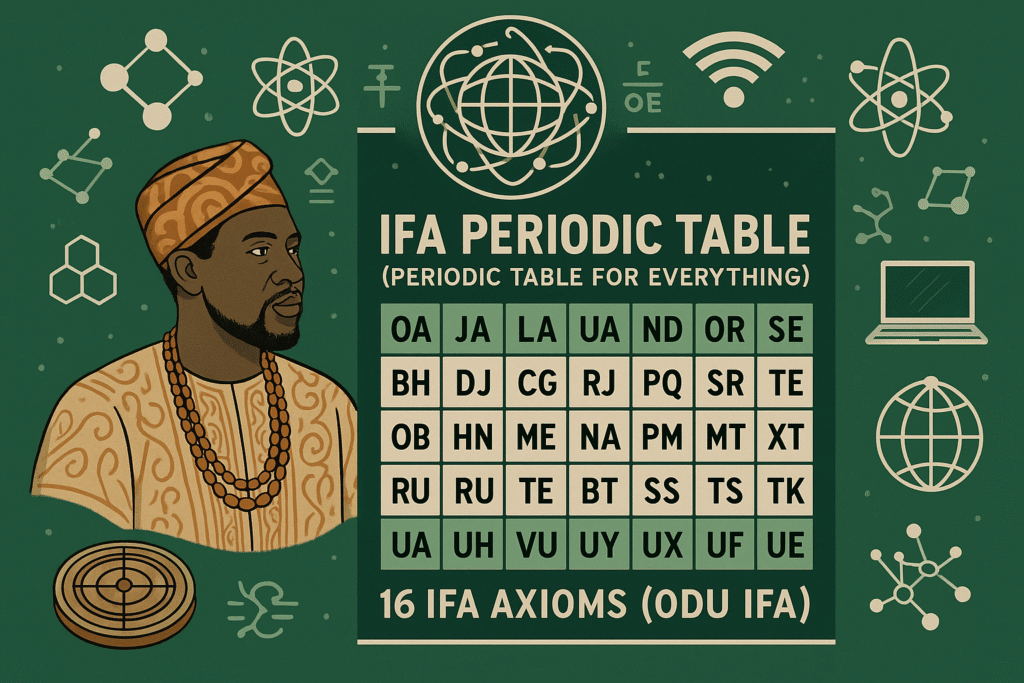
The major features of the Periodic Table of Everything:

  • Unified Knowledge
  • Interdisciplinary Insights
  • Innovative Modeling
  • Global Standards
  • 16 Ifa Axioms
  • Mathematical Precision
  • Periodic Table Generator
  • Polymathic System