
IfaLens: ToELens
Introducing the Ifa Approach: The ToE Approach
Ifa Lens is a tool in the IFA System that allows you to learn all subjects and look at issues with a polymathic approach from all angles possible (and impossible).
ToELens enables the unification and integration of all dimensions of knowledge mathematically within the TOE, also known as the IFA Internet, the IFA Body of Knowledge (IFABOK), or Odu Ifa.
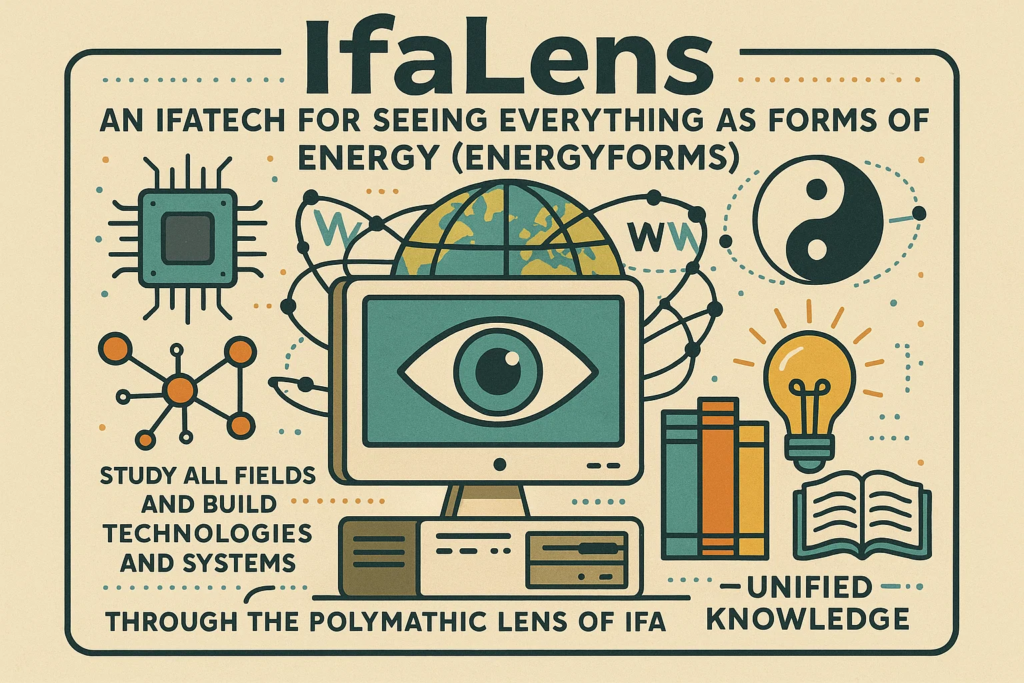
IfaLens is simply an IfaTech for making everything (knowledge, information, physical objects, anything at all) look unified and deeply integrated with every other thing.
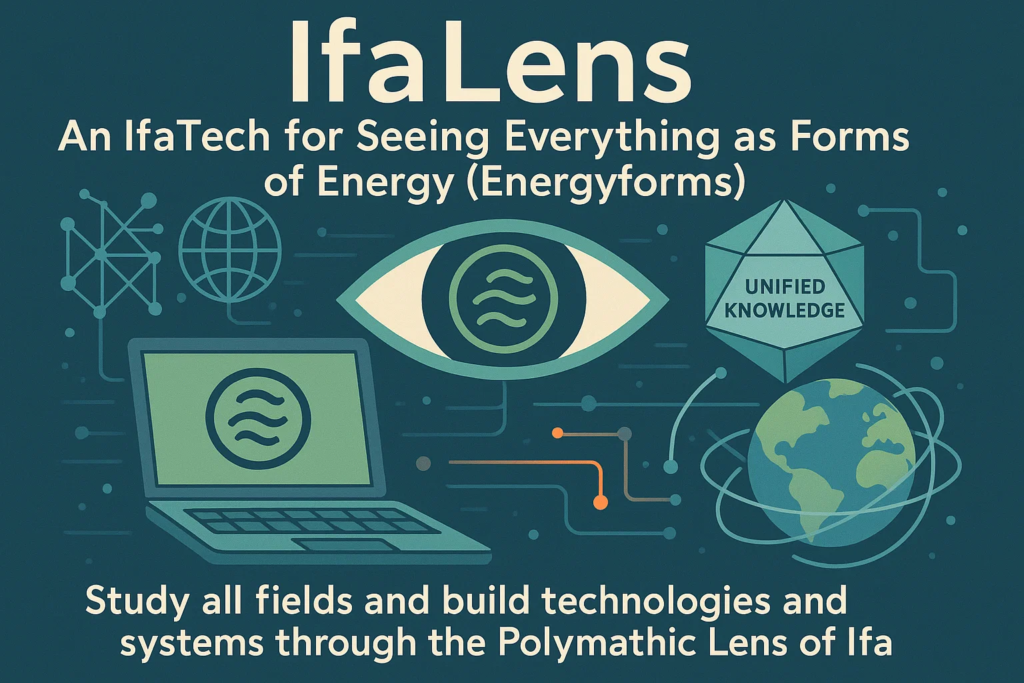
Discover the Power of the Ifa Lens
Take a sneak peek into the core concepts of the phenomenon, IfaLensing.
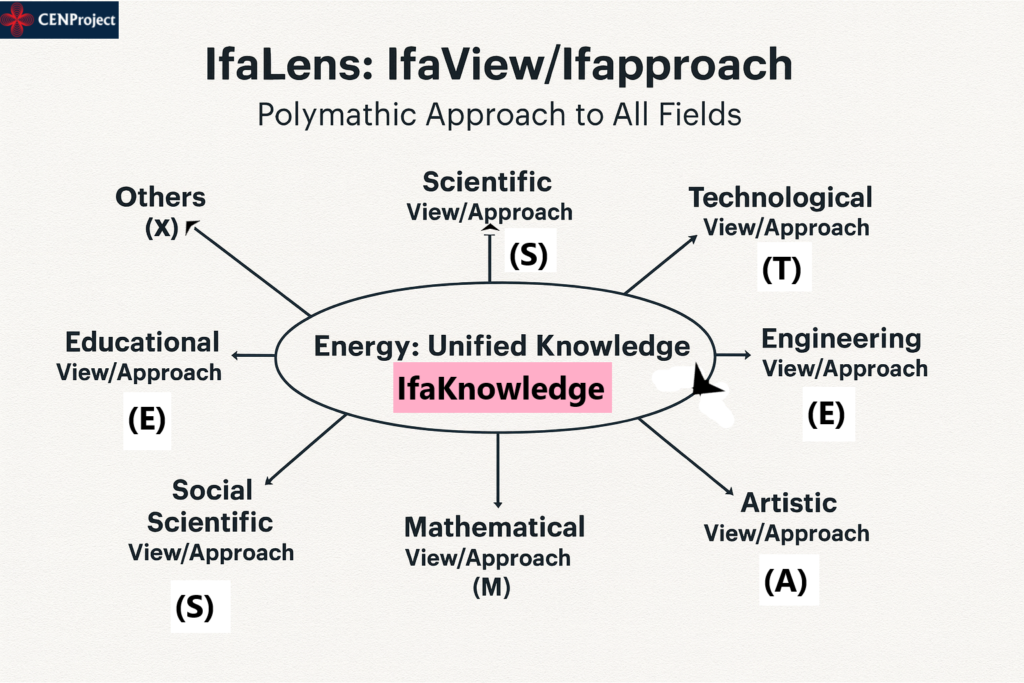
Holistic Perspective
Ifapproach is a unified and universal approach that integrates knowledge mathematically across all disciplines using Ifa Numbers and Ifa Algebras.
Ifa Mechanics: Consciousness Mechanics
An innovative framework for formalizing and studying all fields of knowledge as energyforms or energyfields within the IFA Internet.
CODAR Technology
Consciousness Detecting and Ranging (CODAR) systems are advanced systems designed to detect and sense consciousness.
IFA Mathematics
Ifamathematical models that analyze phenomena using IFABits.
Explore Integrated Systems
These Ifa Technologies, also known as the Technologies for Everything (TechoE), are vital elements of IFA Mathematics:

Ifa Sensors
These are the Sensors for Everything (SensoEs), also known as ToE Sensors.
Ifa Glasses
IfaGlasses are the Glasses for Everything (GlassoEs), also known as ToE Glasses, for broadening the scope of our vision as humans safely beyond the visible segment (ordinary light) in EM spectrum.
Ifa Approach
Learn the ToE Approach and the mechanics governing consciousness and perception.
Ifa Systems
Ifa Systems are the Systems for Everything (SystoE). Discover SystoEs, which are advanced sensors/detectors, telescopes, cameras, glasses, simulators, and maps for extending vision scope, modeling in IFABOK and consciousness studies.
Ifascopy (ToEScopy): The Unified Field of Imaging
Telescopy is the art, science, and practice of making and using telescopes to observe distant objects, often in astronomy, through the collection of electromagnetic radiation. It involves detecting visible light, radio waves, and other radiation types to study objects in the universe.
Microscopy is the technical field and scientific practice of using microscopes to visualize samples, structures, and objects that are too small to be seen by the unaided human eye. It enables the examination of minute details, such as cells, microorganisms, or surface textures, by utilizing lenses, electrons, or probes to produce magnified images.
Microscopy involves the study of objects that are too small to be examined by the unaided eye.
Ifascopy involves the mathematical and holistic study of objects at the most fundamental level of Ogbe Energy (CEN) that cannot be naturally perceived by key parts of the body, including the eye, ear, and others. Ifascopy is an interdisciplinary field of IFABOK that cuts across of every field of knowledge.
Ifascopes are ẹ̀rọ ìfigbogbo-ara-ríran.
Also known as IfaImaging or ToEImaging, Ifascopy provides a Grand Map of how humans convert reality into perceivable form. The Ifa Imaging System is a general Framework that captures all kinds of imaging systems, tools, techniques, and devices, including telescopes, microscopes, scanners, and many others.
Ifa Imaging is a unified and integrated field of imaging, moving from classical optics to quantum-scale tools and abstract systems.
Foundations: What is “Imaging”?
At a deeper level, imaging is built on three steps:
- Interaction — energy interacts with a system (light, electrons, sound, fields)
- Transformation — the device encodes that interaction
- Representation — output becomes visible, audible, or measurable
Imaging = Energy → Transformation → Perception
Microscopy (Imaging the Very Small)
Optical Microscopy
Uses visible light and lenses.
- Bright-field, dark-field, phase-contrast
- Fluorescence microscopy (tagged molecules glow)
Limit: diffraction (~200 nm resolution)
Electron Microscopy
Uses electrons instead of light.
- Transmission Electron Microscopy (TEM) → internal structure
- Scanning Electron Microscopy (SEM) → surface topology
Resolution: atomic scale (~0.1 nm)
X-ray Microscopy
Uses high-energy photons.
- Penetrates dense materials
- Used in crystallography and materials science
UV & Infrared Microscopy
- UV → higher resolution than visible light
- Infrared → chemical composition imaging
Scanning Probe Microscopy (Nanoscopes)
Atomic-scale interaction-based imaging:
- Scanning Tunneling Microscope
- Uses quantum tunneling current
- Atomic Force Microscope
- Measures atomic forces
👉 These don’t “see” in the traditional sense—they feel and reconstruct reality.
Telescopy (Imaging the Very Large)
Optical Telescopes
- Lenses or mirrors collect light
Radio Telescopes
- Detect radio waves from space
Space Telescopes
- Avoid atmospheric distortion
Example:
- Hubble Space Telescope
Multi-wavelength Astronomy
- X-ray telescopes
- Gamma-ray telescopes
- Infrared telescopes
👉 Each reveals a different layer of the universe
Spectroscopy (Imaging Through Energy Signatures)
Instead of pictures, you get spectral fingerprints.
- Spectroscope
- Mass spectrometry
- NMR (magnetic resonance)
Used to determine:
- Chemical composition
- Molecular structure
- Energy states
Medical Imaging (Inside Living Systems)
Structural Imaging
- X-ray radiography
- CT scans
Functional Imaging
- MRI (magnetic fields + radio waves)
- fMRI (brain activity)
- PET scans (metabolic processes)
Direct Visual Tools
- Endoscope
Acoustic Imaging
- Ultrasound
- Stethoscope
👉 These combine physics + biology + interpretation
Directional & Reflective Imaging
Periscopic Systems
- Periscope
- Redirects line of sight
Borescopes
- Inspect internal cavities
Lidar & Radar
- Use reflected waves to build images
👉 These reconstruct hidden environments
Waveform & Signal Imaging
These convert time-based signals into visual form.
- Oscilloscope
- Voltage vs time
- Seismographs
- EEG/ECG machines
👉 They “image” processes rather than objects
Transformative Optical Devices
These reshape perception creatively:
- Kaleidoscope
- Symmetry generation
- Holography
- Interferometry
👉 These show that imaging can also be generative
Computational Imaging
Modern imaging often happens in software:
- AI-enhanced imaging
- Tomographic reconstruction
- Simulation-based imaging
Examples:
- MRI reconstruction algorithms
- Computational photography
👉 The “image” may never physically exist—only mathematically
Quantum & Emerging Imaging
- Quantum sensing
- Neutrino detectors
- Dark matter detection systems
These detect extremely weak or indirect signals.
Remote & Environmental Imaging
- Satellite imaging
- Thermal cameras
- Hyperspectral imaging
Used in:
- Climate science
- Agriculture
- Defense
Cognitive & Abstract Imaging
Not physical devices, but powerful:
- Data visualization
- Mathematical modeling
- Graphical simulations
👉 These image relationships and structures
Image Classification
All imaging systems can be grouped by what they detect:
| Domain | Energy Type | Example Device |
|---|---|---|
| Optical | Photons | Microscope, Telescope |
| Electronic | Electrons | Electron microscope |
| Mechanical | Force | AFM |
| Acoustic | Sound | Stethoscope |
| Electromagnetic | RF/X-ray | MRI, Radar |
| Quantum | Probability fields | STM |
| Computational | Data | AI imaging |
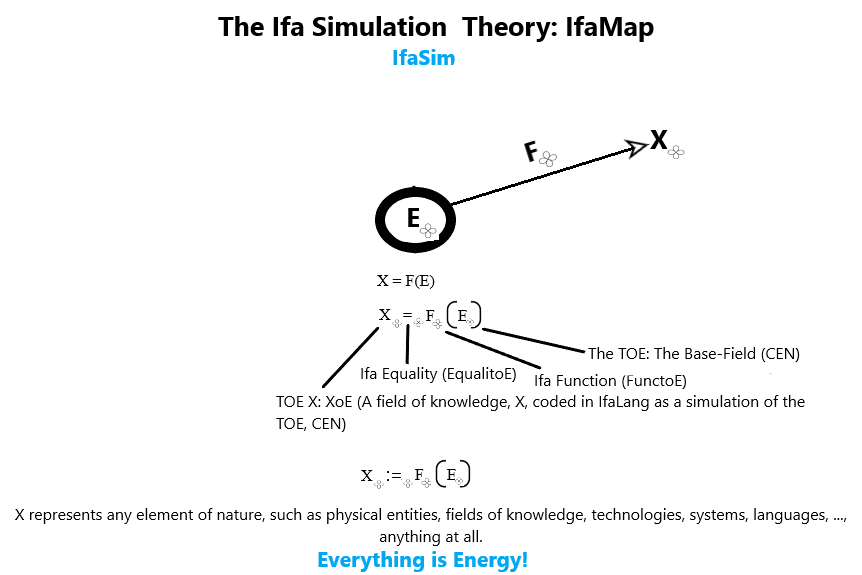
Every imaging device, X, can be mathematically reduced to the energyform called Odu:
A Meta-Function (Transformtion) of Energy
Become a Polymath
Learn how to use Ifapproach to study all fields of knowledge and build applications of your knowledge as Ifa Technologies (IfaTech) and Ifa Systems (IfaSystems) to solve complex problems in society.
Unlock new dimensions of knowledge by joining Ifacodemy and our community today, enabling you to stay ahead with groundbreaking insights.