
An Invitation to the Relational Universe
Explore the core Principles of the Ifa Relation, a metamathematical framework that unifies diverse disciplines through set-theoretic integration, revealing the interconnected fabric that shapes all fields and systems.
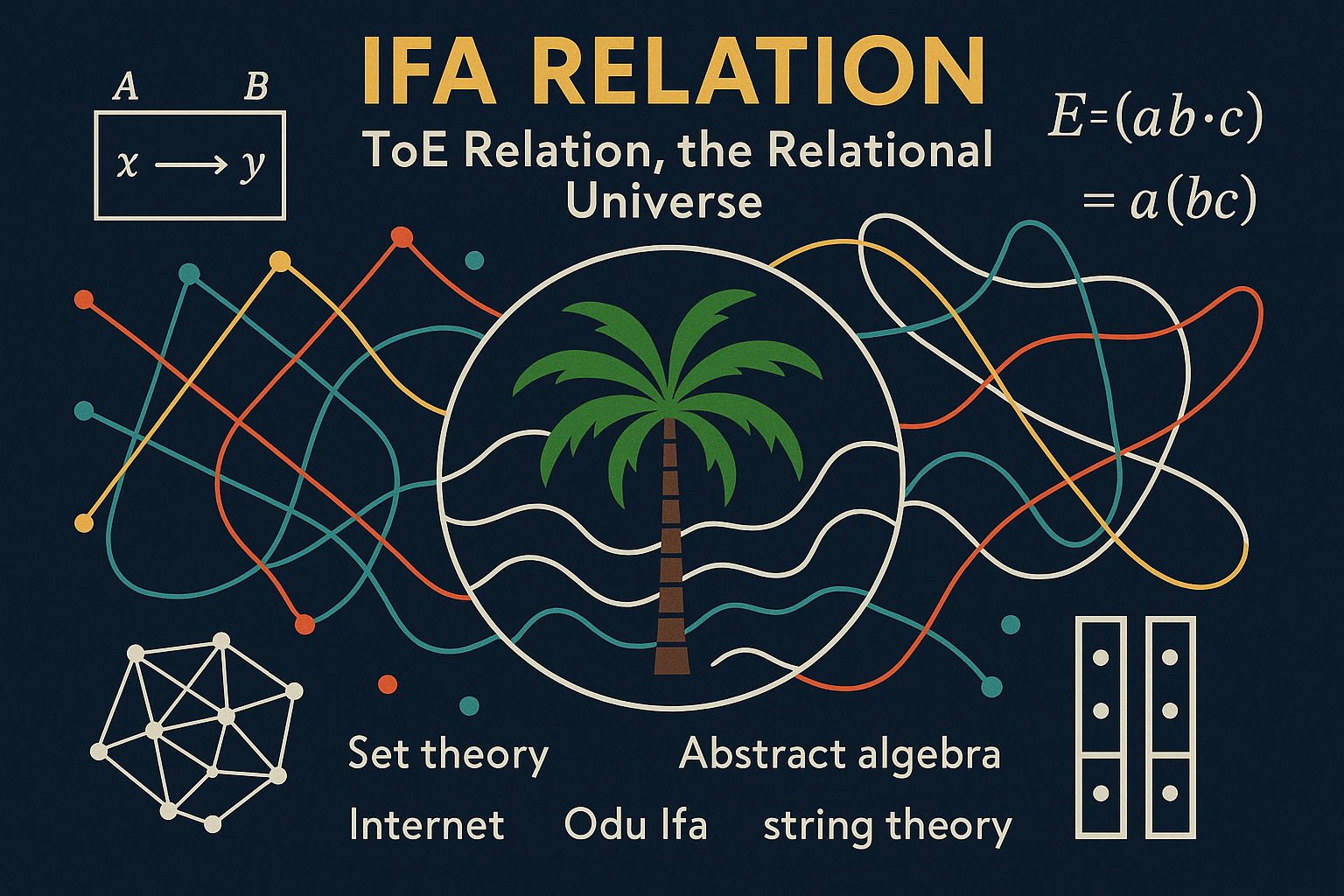
IfaRelation: The Relation of All Relations
Dive into essential resources that illuminate the core Principles of IFAMathematical integration of all fields.

Set-Theoretic Foundations
Understand the mathematical base that unifies diverse scientific and technological domains.
Relation of Everything
Examine how the Relation of Everything (ReloE) interconnects multiple disciplines through a unified approach.
Energy Relation Insights
Gain foundational knowledge on the energy dynamics shaping IFAMath’s meta-structure.
Application Spectrum
Explore practical applications demonstrating IFAMath’s ability to integrate complex systems.
IFA: The Study of Everything
Everything Theory
As the Theory of Everything (TOE), IFA is the Study of Everything. On the IFA Internet, the acronym, TOE, also means the Totality of Existence. Hence, IFA provides the Standard Model of the TOE (Totality of Existence).
Ifa is the universal link that shows the interrelations of all fields and disciplines of knowledge.
For any form of knowledge, X, X theory is the study of X:
Mathematics and Abstract Structures
| Theory | Object of Study (X) | Field / Domain | Definition (summary) |
|---|---|---|---|
| Group theory | Groups | Algebra | Study of algebraic structures with one associative operation and inverses. |
| Ring theory | Rings | Algebra | Study of sets with two operations (addition and multiplication). |
| Field theory | Fields | Algebra | Study of algebraic fields and their extensions. |
| Module theory | Modules | Algebra | Study of modules as generalizations of vector spaces. |
| Matrix theory | Matrices | Linear algebra | Study of matrices and their transformations. |
| Vector theory | Vectors | Linear algebra | Study of vectors, spaces, and linear operations. |
| Set theory | Sets | Foundations of math | Study of sets and membership relations. |
| Number theory | Numbers | Arithmetic | Study of integers and their properties. |
| Order theory | Orders | Algebra / Logic | Study of ordered sets and relations. |
| Lattice theory | Lattices | Algebra / Logic | Study of structures where every pair of elements has a meet and join. |
| Graph theory | Graphs | Discrete math | Study of vertices connected by edges. |
| Knot theory | Knots | Topology | Study of embeddings of circles in 3D space. |
| Topology (Topological theory) | Topological spaces | Geometry | Study of spatial properties preserved under deformation. |
| Measure theory | Measures | Analysis | Study of measures, integration, and measurable spaces. |
| Probability theory | Probabilities | Statistics | Study of random phenomena and distributions. |
| Combinatorics (Combinatorial theory) | Combinations | Discrete math | Study of counting, arrangement, and structure. |
| Category theory | Categories | Foundations / Meta-math | Study of objects and morphisms, unifying all of mathematics. |
| Representation theory | Representations | Algebra | Study of how algebraic structures act on vector spaces. |
| Operator theory | Operators | Functional analysis | Study of linear operators and their spectra. |
| Spectral theory | Spectra | Analysis / Physics | Study of eigenvalues and eigenfunctions. |
| Coding theory | Codes | Information science | Study of designing systems for data transmission and error correction. |
Logic, Computation, and Lingustics
| Theory | Object of Study (X) | Field / Domain | Definition (summary) |
|---|---|---|---|
| Model theory | Models | Mathematical logic | Study of the relationship between formal systems and their models. |
| Proof theory | Proofs | Logic | Study of formal proofs as mathematical objects. |
| Type theory | Types | Logic / Computer science | Study of systems classifying terms by their kinds. |
| Recursion theory | Recursive functions | Computability | Study of computable functions and decision problems. |
| Automata theory | Automata | Computer science | Study of abstract machines and computation. |
| Computation theory | Computations | Theoretical CS | Study of what can be computed. |
| Complexity theory | Computational complexity | CS / Math | Study of efficiency and difficulty of computational problems. |
| Algorithmic information theory | Information | CS / Math | Study of randomness and compressibility in data. |
| Formal language theory | Languages | CS / Linguistics | Study of syntactic structures and grammars. |
Physics and Natural Sciences
| Theory | Object of Study (X) | Field / Domain | Definition (summary) |
|---|---|---|---|
| Relativity theory | Relativistic systems | Physics | Study of space, time, and gravity. |
| Quantum theory | Quantum states | Physics | Study of microscopic phenomena governed by wavefunctions. |
| Field theory | Fields | Physics | Study of continuous fields like electromagnetic or gravitational. |
| String theory | Strings | Theoretical physics | Study of fundamental particles as one-dimensional strings. |
| Chaos theory | Chaotic systems | Nonlinear dynamics | Study of systems sensitive to initial conditions. |
| Thermodynamic theory | Heat and energy | Thermodynamics | Study of energy transfer and entropy. |
| Control theory | Control systems | Engineering / Physics | Study of regulation and feedback in systems. |
| Information theory | Information | Physics / Communication | Study of entropy, information, and transmission limits. |
| Electromagnetic theory | Electromagnetic fields | Physics | Study of electric and magnetic interactions. |
Art, Humanities, and Applied, Social, and Decision Sciences
| Theory | Object of Study (X) | Field / Domain | Definition (summary) |
|---|---|---|---|
| Art theory | Art | Aesthetics / Art Studies | Study of the nature, meaning, principles, and interpretation of art. |
| Humanities theory | Humanities | Humanities/Cultural Studies | Study of human culture, expression, interpretation, and meaning-making across literature, philosophy, history, and the arts. |
| Legal theory (Jurisprudence) | Law | Law/Legal Philosophy | Study of the nature, structure, sources, interpretation, and philosophy of law. |
| Game theory | Games (strategic interactions) | Economics/CS | Study of rational decision-making among interacting agents. |
| Decision theory | Decisions | Economics/ Psychology | Study of choices under risk and uncertainty. |
| Utility theory | Utility | Economics | Study of preference, value, and satisfaction optimization. |
| Network theory | Networks | Systems science | Study of interconnected nodes and their interactions. |
| Queuing theory | Queues | Operations research | Study of waiting lines, service systems, and resource allocation. |
| System theory | Systems | Systems science | Study of complex systems composed of interacting parts. |
| Information theory (social) | Information | Communication/ Sociology | Study of encoding, transmission, and interpretation of information among agents. |
| Learning theory | Learning | Education/AI/ Psychology | Study of how humans or machines acquire, update, and organize knowledge. |
Philosophical and Conceptual Theories
| Theory | Object of Study (X) | Field / Domain | Definition (summary) |
|---|---|---|---|
| Knowledge theory (Epistemology) | Knowledge | Philosophy | Study of knowledge, justification, and belief. |
| Truth theory | Truth | Philosophy / Logic | Study of the nature and correspondence of truth. |
| Value theory (Axiology) | Value | Philosophy | Study of ethics, aesthetics, and worth. |
| Relational theory | Relations | Metaphysics / Logic | Study of how relations constitute reality. |
| Complexity theory (general) | Complexity | Systems science | Study of emergence and adaptive order. |
| Meaning theory (Semantics) | Meaning | Linguistics / Philosophy | Study of meaning, reference, and interpretation. |
| Concept theory | Concepts | Cognitive science | Study of mental representations and categorization. |
All these are encoded in IfaLang as energyforms/energyfields, with Energy revealed as the ToE Pattern and Universal Structure of Knowledge as a whole.
Every “theory” abstracts an entity (the X – energyform) and studies its relations, transformations, and properties.
Ifa Operations, Ifa Functions, and Ifa Mappings
In IFABOK, IfaRelation is the relational universe where all kinds of relations, operations, mappings, and functions, including binary operations and related concepts like arity, reside as conscious entities. Discover how Ifanary relations encompasses n-ary relations and n-ary operations in Mathematics and Computing.
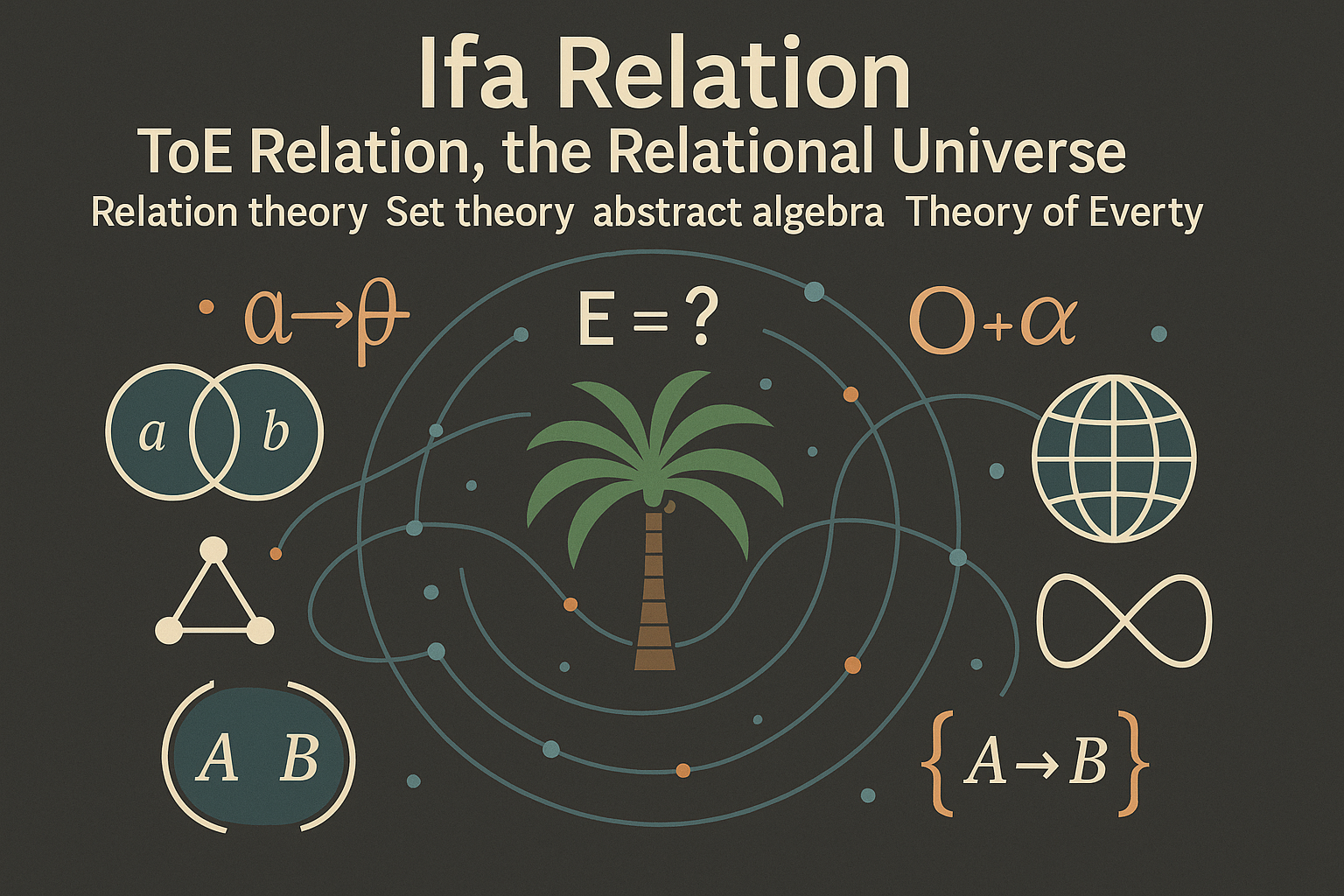
Mathematical Framework Insights
Delve into the comprehensive meta-structure that supports unified theories in IFA Mathematics.
Begin Your Journey Into Unified Knowledge
Discover how the Ifa Relation integrates diverse fields and disciplines through a powerful mathematical framework.
- Unified Set-Theoretic Foundation
- Everything Theory
- Cross-Disciplinary Connectivity
- Comprehensive Mathematical Model
- Polymathic Learning Model
- Applications Across Technologies
- Insight Into System Integration
- The Study of Everything
